Beard Transplant NYC: Facial Hair Restoration at Our Park Avenue Office
Kopelman Hair Restoration performs beard transplants using FUE and FUT techniques at our Park Avenue office in New York City. During a private consultation, the surgeon evaluates your donor supply and goals, then designs a beard that blends naturally with your existing facial hair. Call (212) 470-4076 or book online to schedule your consultation.
Facial hair restoration has advanced considerably with Follicular Unit Excision (FUE) and the strip method (FUT). Both techniques produce natural, well-angled growth that blends with existing facial hair.
If you are considering facial hair surgery, Dr. Kopelman will evaluate donor density, facial symmetry, existing growth pattern, and healing potential before recommending a technique.
You can explore everything you need to know about clinic selection, pricing, and recovery in our complete beard transplant article.
Risks and Possible Complications
- Poor angulation: Despite careful site creation, some grafts may grow at a steeper angle than surrounding hair. Affected grafts can usually be removed or redirected.
- Small bumps or cysts: Ingrown hairs and inclusion cysts can occasionally form, most often in the goatee area beneath the lower lip. These may need to be drained or excised.
- Uneven or poor regrowth: Rare, since the face has an excellent blood supply, but not impossible. A touch-up session may be needed.
- Temporary redness, swelling, and crusting: Expected in the first one to two weeks in both the donor and recipient areas.
- Donor site scarring: FUE leaves small dot-like marks; FUT leaves a linear scar that is concealed by longer hair.
- Infection: Uncommon, and typically prevented with prescribed oral and topical antibiotics.
What are FUE and the Strip Method for a Beard Implant
Both approaches relocate living hair follicles to the face. FUE is less invasive and extracts individual follicles, leaving minimal scarring and allowing for a quicker recovery.
The FUT method removes a strip of scalp skin containing follicles and transplants them to the beard area. It may leave a linear scar, but it is efficient for harvesting large graft numbers, and the scar is usually concealed by surrounding hair.
| Factor | FUE (Follicular Unit Extraction) | FUT (Strip Method) |
|---|---|---|
| How grafts are taken | Individual follicles removed with a micro-punch tool | A strip of scalp is removed, then dissected into follicular units |
| Scarring | Tiny dot-like marks spread across the donor area | A single linear scar, concealed by surrounding hair |
| Recovery time | Shorter; no sutures, small wounds heal quickly | Longer; sutures and linear closure need time to heal |
| Graft quality | Slightly higher handling risk, minimized by modern technique | Often high quality due to less handling per follicle |
| Best for | Short hairstyles, smaller graft counts, patients concerned about linear scarring | Large graft counts and patients who keep scalp hair longer |
Dr. Kopelman will recommend the most effective method for your case, FUE or FUT, based on your donor supply, hairstyle preference, and desired outcome. The planning phase includes detailed photographs of the beard area for precision and aesthetic accuracy.
These techniques allow precise beard shaping and a more natural, defined result. They are especially useful for beard transplants in patchy beard cases, thin growth, or uneven coverage, where a fuller line is the goal.
Beard Transplant Consultation
Private Consultation for Facial Hair Restoration with Dr. Kopelman
Begin your beard restoration journey with a private consultation at our Park Avenue office. We'll discuss your goals, review your medical history, and examine your donor hair density. Based on this assessment, we'll recommend FUE or FUT and build a design plan tailored to your facial structure.
Reviewing Medical History (FUE and FUT)
Your medical history is central to determining the right approach. Family history of hair loss, genetic influences, and personal health conditions affecting hair growth are all considered. Blood tests or follicle analysis may be recommended to tailor your plan.
Tailored Recommendations
Dr. Kopelman will suggest the most effective method for your case, FUE or FUT, based on your individual needs and desired outcome. The planning phase includes detailed photographs of the beard area for precision and aesthetic appeal.
Who Should Not Have a Facial Hair Transplant
Certain conditions make surgery inadvisable, at least until they are treated or stabilized:
- Active scarring alopecia or alopecia areata. Autoimmune activity can attack transplanted follicles the same way it attacked the originals.
- Insufficient donor supply. If the scalp cannot spare the grafts, the procedure cannot deliver meaningful density.
- Medical conditions incompatible with local anesthesia containing epinephrine. These must be reviewed before scheduling.
- Uncontrolled bleeding disorders or unmanaged systemic illness. Healing and graft survival both depend on stable health.
- Unrealistic density expectations. No surgeon can exceed what donor supply and hair caliber allow
Am I a Candidate for Facial Hair Transplant with FUE or the Strip Method?
To determine suitability:
- Ideal for those with patchy, sparse, or uneven facial hair
- Suitable for men and for transmasculine patients seeking a fuller, more masculine hair pattern
- Requires sufficient donor hair density, usually from the back and sides of the scalp
- Choice between FUE and the strip method depends on individual needs and the extent of restoration required
- Non-smokers generally show better healing and outcome
- Realistic expectations about achievable density, which is limited by donor supply and hair caliber
Donor supply is a shared resource. The same follicles used for facial hair grafting are the ones that would later be used for scalp restoration, so the plan must account for the possibility of future scalp thinning.
If you are specifically interested in procedures tailored for different ethnicities, explore our Asian beard transplant guide for unique considerations.
Beard Design Styles and Graft Counts
Common design goals include filling cheek gaps, thickening a goatee, restoring sideburns, closing the gap between the mustache and the chin, or building a full beard from sparse growth.
The surgical approach is similar across these styles. What changes is the number of grafts, the recipient site pattern, and the angle at which each follicle is placed.| Design goal | Typical graft range | Notes |
|---|---|---|
| Sideburns and chin fill | ~1,200 | Based on a published patient case, age 29 |
| Patchy areas, even coverage | ~1,500 | Based on a published patient case, age 33 |
| Denser mustache and goatee | ~1,800 | Based on a published patient case, age 35 |
| Full beard, improved symmetry | ~2,000 | Based on a published patient case, age 38 |
| Maximum density full beard | Higher counts possible | Limited by donor supply and hair caliber; confirmed at consultation |
Procedure of
Beard Transplant
STEP 01
Consultation
- Initial Assessment: The surgeon assesses your facial hair and discusses goals, expectations, and desired beard style.
- Medical History: A review of your medical history to confirm you are a good candidate for surgery.
- Planning: A customized treatment plan is created, detailing graft count and overall design.
STEP 02
Preparation
- Pre-Surgery Instructions: Patients receive guidelines on how to prepare, such as avoiding blood-thinning medications and supplements and refraining from smoking.
- Shaving: The donor area, usually the back of the scalp, is trimmed to allow follicle extraction.
- Anesthesia: Local anesthesia numbs both the donor area and the recipient area on the face.
STEP 03
Donor Hair Extraction
- Punch Extractions: Individual follicles are extracted using a micro-punch tool.
- Minimal Scarring: This method leaves tiny, dot-like marks that are barely noticeable.
STEP 04
Preparing the Grafts
STEP 05
Creating Recipient Sites
- Incision Making: Tiny incisions are made in the beard region following the natural pattern of facial hair growth.
- Design and Density: The surgeon controls beard shape, density, and growth direction at this stage.
Implanting the Grafts
- Placement: Prepared follicles are meticulously implanted into the recipient incisions.
- Orientation: Each graft is placed at the natural angle and direction of facial hair growth to ensure a realistic result.
Post-Procedure Care
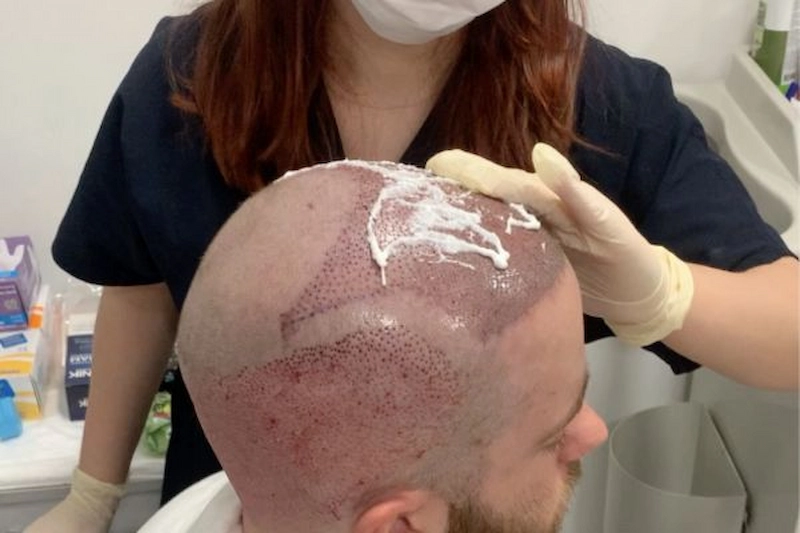
- Immediate Care: The face is gently cleaned, and a protective dressing may be applied.
- Recovery Instructions: Patients receive detailed instructions for the transplanted area and the donor site, which may include medication to manage discomfort and reduce swelling.
Recovery and Growth
- Initial Healing: Redness, swelling, and minor tenderness are normal for a few days.
- Shedding Phase: Transplanted hairs may fall out within the first few weeks. This is expected and temporary.
- New Growth: New growth typically begins within 3 to 4 months, with visible improvement around 6 to 9 months and full results at 12 to 18 months.
Follow-Up
Preparing for Your
Facial Hair Transplant in NYC
Specific preparations are made under Dr. Kopelman’s guidance, whether you are undergoing FUE or FUT. Both involve harvesting follicles from a donor area, typically the scalp, and transplanting them to the face. Local anesthesia is used for comfort.
Stop blood-thinning supplements and over-the-counter medications in the window your surgeon specifies. Avoid alcohol and smoking in the days beforehand, since both interfere with healing and graft survival.
Shower the night before or the morning of your appointment to reduce the risk of infection, and arrange a ride home if a sedative is part of your protocol.
Beard Hair Transplantation with Drs. Kopelman
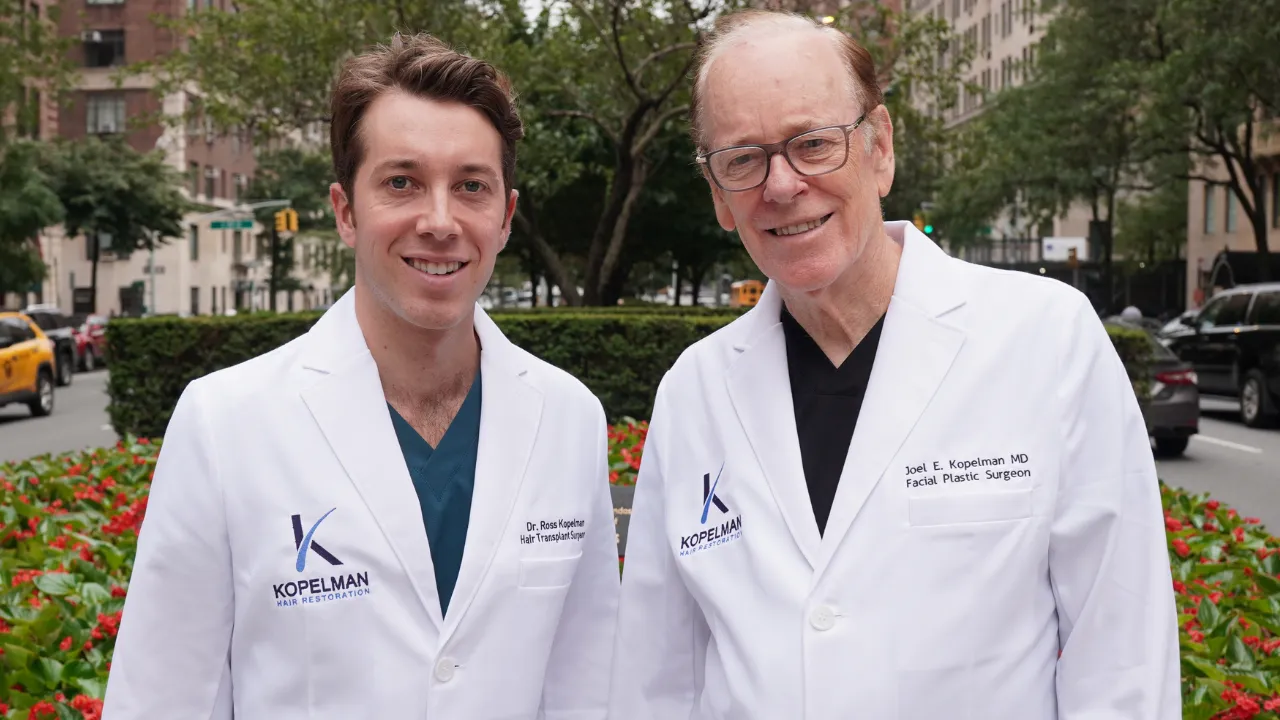
Dr. Ross Kopelman (NY License #307924) trained at Cornell University, New York University, and New York Medical College before joining Kopelman Hair Restoration. Together with his father, Dr. Joel Kopelman, he brings 40+ years of combined hair restoration experience to every beard transplant performed at our Park Avenue office.
Beard Hair Transplant
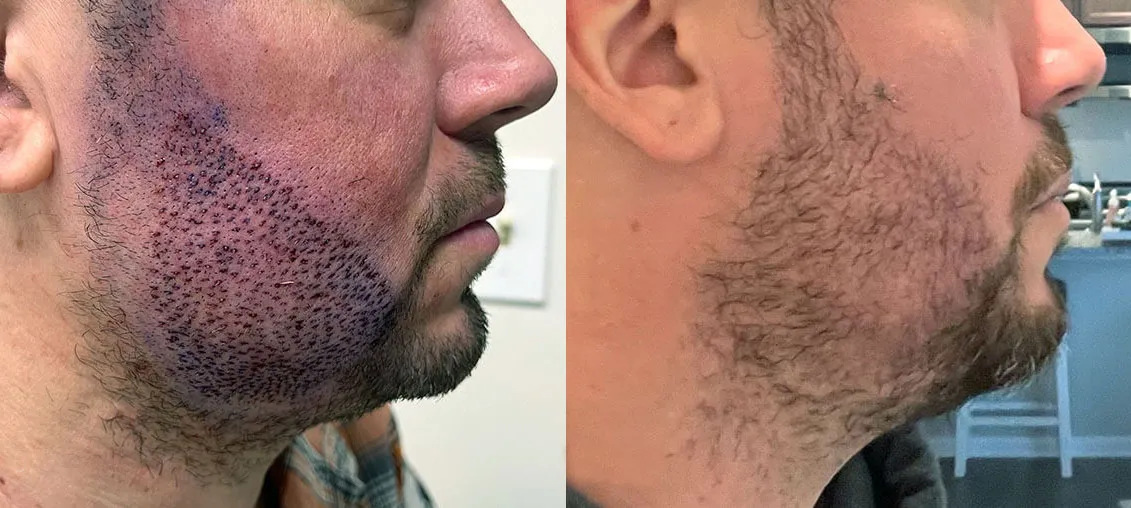
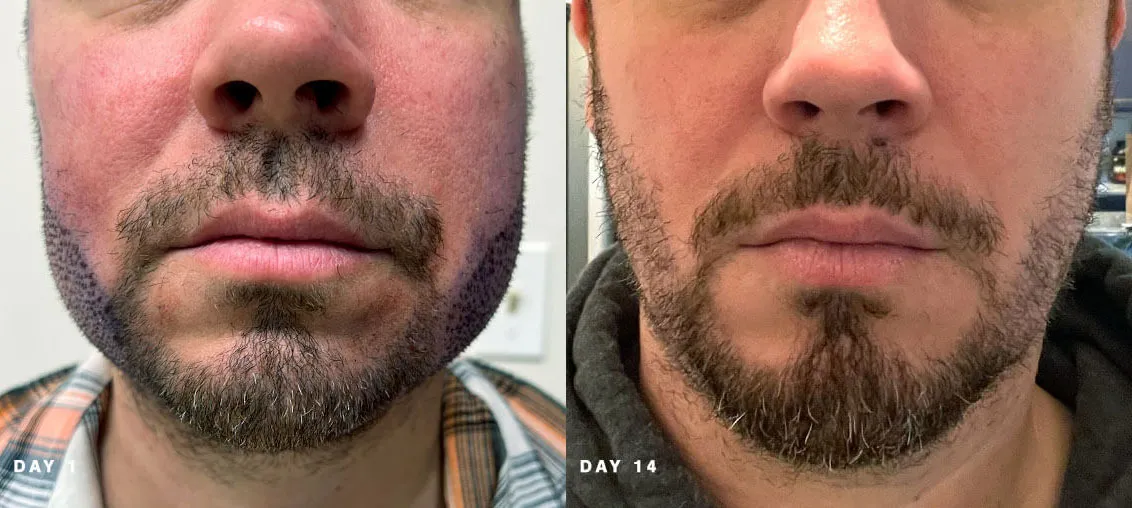
Before and After Photos
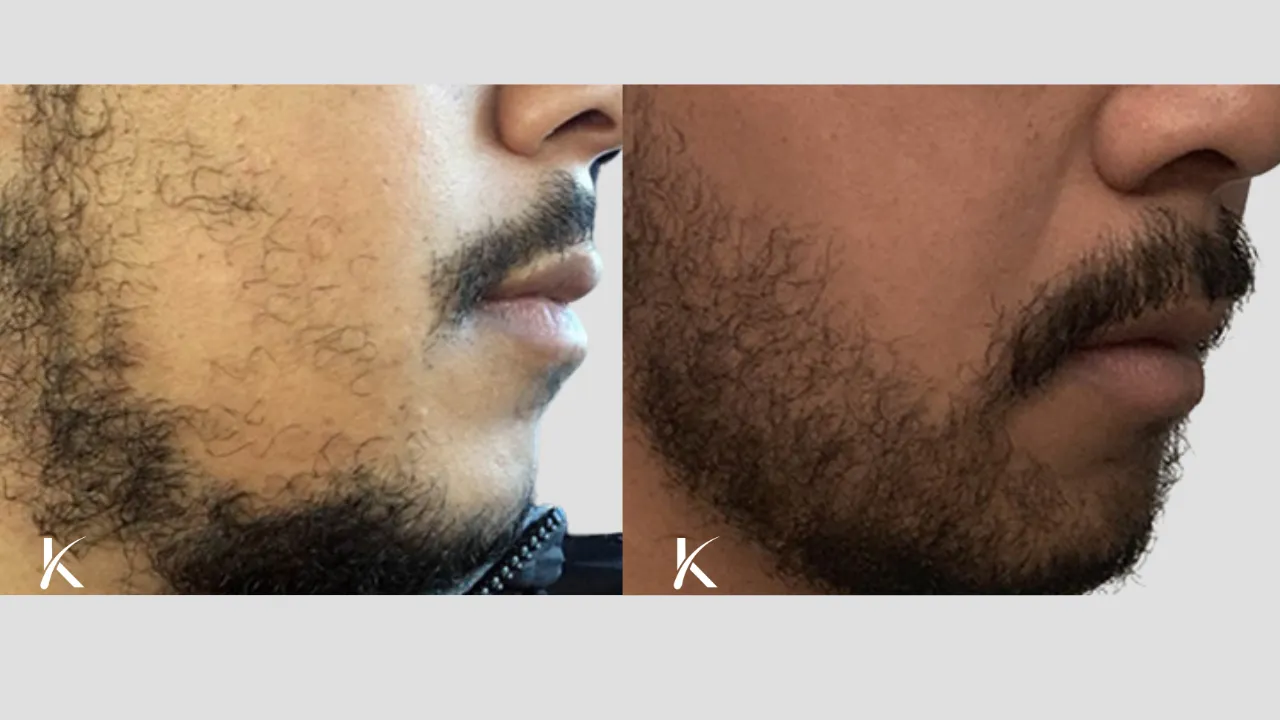
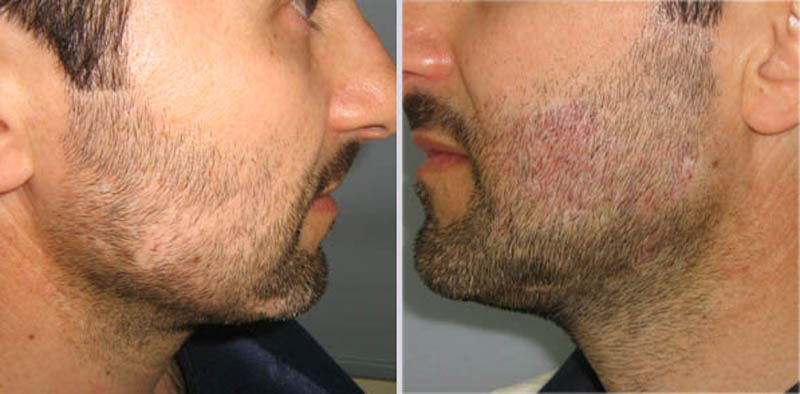
Recovery After a Facial Hair Transplant in New York City
Swelling and tenderness are normal for the first one to two weeks. Transplanted hairs typically shed within the first few weeks, which is a normal part of healing. New growth begins around 3 to 4 months, with significant improvement visible by 6 to 9 months and full results by 12 to 18 months. Most patients can shave or trim the area 10 days to 2 weeks after surgery, once the grafts have taken. Follow your surgeon’s specific timeline rather than a general rule.
| Timeframe | What to expect |
|---|---|
| Days 1 to 5 | Redness, mild swelling, small crusts. Keep the transplanted area dry as instructed. |
| 1 to 2 weeks | Crusting resolves. Most patients are comfortable returning to normal routines. |
| Around 10 to 14 days | Shaving or trimming is typically permitted once grafts have set. |
| 2 to 6 weeks | Transplanted hairs shed. This is expected and temporary. |
| 3 to 4 months | New permanent growth begins. |
| 6 to 9 months | Noticeable density and improved coverage. |
| 12 to 18 months | Final result, fully blended with existing facial hair. |
Patients exploring facial hair procedures in the city often compare options such as beard surgery and an eyebrow transplant in New York for comprehensive facial restoration.
Request a
Consultation
Call our New York office at (212) 470-4076 or complete the form. Virtual consultations are also available for patients to make it convenient to access Dr. Kopelman.
You will leave feeling confident about how to best address your hair restoration journey.
NEW YORK CITY
Schedule a Consultation
What Our
Patients Are Saying
Posted on Google
 barret abramow
 I recently had a FUE hair transplant with Dr. Kopelman in New York City, and I couldn’t be more pleased with the results. I had 2,800 grafts focused on restoring my hairline, which had become more recessed than I was comfortable with. The change has been subtle yet transformative — my hairline looks completely natural, and it frames my face in a way that feels more like me. It’s not overly dramatic, just exactly what I hoped for. What really stood out about working with Dr. Kopelman and his team was their expertise and attention to detail. From the initial consultation, it was clear they understood how to approach my specific situation to achieve the best outcome. The procedure itself went smoothly, and the aftercare instructions were thorough and easy to follow. I felt confident every step of the way because of how knowledgeable and professional they were. Finding their practice in NYC was a relief — it’s not easy to trust just anyone with something as personal as your hairline. I’m really glad I chose them because they delivered excellent results without any of the typical hype. If you’re considering a hair transplant, this is definitely the team to go to.Posted on Google
 Beth ZimmermanI am very happy with my experience with Dr. Kopelman. They are an amazing team. I had been looking for physician who could address my hair loss that had been bothering me for years. I am now doing mesotherapy treatments and I am so happy that my hair loss has reverted over the past 4 months. I really appreciated that a hair transplant was not forced upon me but is instead a last resort. I really appreciate the honesty. Thank you!Posted on Google
 Yoel OhayonI can’t say enough great things about my experience with Dr. Kopelman and the entire team at Kopelman Hair Restoration! I had my hair transplant last year, and the results are simply fantastic. I am fully recovered and thrilled with the transformation—my hair looks natural, and I feel like myself again. Every step of the process was handled with such expertise and care. Dr. Kopelman took the time to explain everything thoroughly, and his team was kind, professional, and supportive from start to finish. I’m beyond grateful for their exceptional work and highly recommend Kopelman Hair Restoration to anyone considering a hair restoration procedure.Posted on Google
 RickDr. Kopelman is extremely knowledgeable and was willing to talk through my concerns and needs to develop an optimal treatment plan. He helped me evaluate a variety of options and decide on a protocol I was comfortable with. I am happy I found him!Posted on Google
 David CohenMy experience with Dr. Kopelman has been nothing short of incredible. From the moment I stepped into his office, I could tell I was in the hands of a true expert. I came to him for both an eyebrow hair transplant and an FUE hair transplant, and I am very happy with the results. My eyebrows look so natural, and the precision and artistry he brought to my FUE procedure completely transformed my hairline. What really stood out was how comfortable and confident he made me feel throughout the process—he explained everything in detail and answered all my questions with such patience and care. I actually discovered him on YouTube, where his videos about hair loss and transplants are so informative, and I’m so glad I did. I’ve never felt more confident in my appearance, and it’s all thanks to Dr. Kopelman’s expertise and attention to detail. If you’re looking for the best hair surgeon in NYC, he’s the one to trust.Posted on Google
 Yedidyah Leo SamuelsDr. Ross is incredible! So much knowledge and expertise in the field. Best hair surgeon in New York City!!Posted on Google
 Juan FraustroI paid for a consultation with one Dr. Kopelman and I actually got both Dr’s Kopelmam. They spent over an hour with me carefully studying my scalp, explaining my options, and providing the necessary prescriptions. I cannot recommend this practice or these doctors more highly.Posted on Google
 Odellya SohnisRoss is a top hair transplant surgeon in NYC. He was so kind when I came in. I wanted to understand why my hair was thinning after using a shampoo a dermatologist had sent my way to stop my bad dandruff problem. He was so patient through my 10 million questions, I felt he really cared about what I need instead of feeding into a consumerist magic pill. He also was able to find that I could be balding and give me tips and a prescription and I felt like he saved me from tripping over a ledge I didn't see. Thank you so much!Posted on Google
 K SalalahI've been to many hair specialists, and I can confidently say that Dr. Kopelman and his team stand out for their incredible care and attention. The hair industry is unfortunately filled with people who are simply looking to make a sale, and think little about your longterm goals or happiness. I'm fortunate to have found Dr. Kopelman, who is incredibly attentive, knowledgable, puts my goals and comfort first, and is willing to think outside the box. Six stars!Posted on Google
 Andres DelgadoI had a consultation with Dr. Joel Kopelman. It was worth my time and money. The doctor answered all my questions and provided valuable insights.
Alternatives to Facial Hair Surgery
Not everyone is ready for surgery, and some patients want to try conservative options first.
- Topical minoxidil. Can thicken existing facial hair with consistent use, but the effect stops when you stop applying it, and it is not FDA-approved for use on the face.
- Microneedling. Sometimes used alongside topicals to support growth in thin areas.
- Hair growth supplements. Biotin-based products may support hair quality, though evidence for meaningful beard density gains is limited.
- Hormone therapy. Relevant only for men with clinically low testosterone, and only under medical supervision.
- Grooming and cosmetic products. Beard fillers, dyes, and shaping can create the appearance of fullness without any procedure.
Surgery remains the only permanent option. Non-surgical approaches are best understood as maintenance or enhancement rather than replacement.
FAQ's
Beard Transplant
How long does it take to see the final results?
Can the result look completely natural?
Visibility depends on several factors, including surgical technique, your natural texture, and styling preferences. Advanced trichophytic closure methods, as practiced by the Kopelman surgical team, significantly minimize the scar’s appearance. Patients with moderate-length styles typically find the scar is well concealed by surrounding growth. If scarring is a concern, discuss it during your consultation to understand how it may apply to your case.
Is the procedure painful?
What is the ideal age?
When can I shave again?
In FUE (Follicular Unit Excision), individual hair follicles are extracted one at a time and transplanted to the brow area. This method is less invasive and leaves no linear scar. FUT (Follicular Unit Transplantation), also known as the strip method, involves removing a strip of skin with hair follicles from the scalp and then transplanting these follicles to the brows. FUT can be more efficient for harvesting a larger number of follicles at once but leaves a linear scar.
Does it leave scars?
As with any surgical procedure, there are risks, though they are minimal. Possible side effects include infection, scarring, and unnatural-looking results if not done correctly. Choosing an experienced surgeon minimizes these risks. Some patients may experience temporary swelling or bruising around the eyes.
How does one maintain a beard after surgery?
The recovery period is relatively quick. Most patients can resume normal activities within a couple of days. Mild swelling and bruising around the brow area can occur but typically subside within a few days to a week. Small crusts may form around each transplanted hair but usually flake off within a week. It is important to avoid rubbing or scratching the treated area to ensure proper healing. The transplanted hairs will initially fall out, a normal part of the process, before permanent hair begins to grow in about 3 to 4 months. Full results are typically seen within 6 to 12 months.
What are some alternatives to a beard implant?
Ready to take the first step?
Cost of Beard Transplant in New York City
Pricing is driven primarily by graft count, then by technique, surgeon experience, and clinic location. Because design goals vary so widely, the range across patients is wide. A beard transplant at our Park Avenue office typically costs $25,000 to $30,000, depending on graft count and technique.
A $350 fee covers a full year of consultations, including as many follow-up visits as needed, whether virtual or in-person. This fee does not apply toward the cost of surgery. We do not accept financing for procedures at our New York office.
Dr. Joel Kopelman and Dr. Ross Kopelman are well-known, experienced facial plastic and hair transplant surgeons with a combined 40+ years of expertise. Dr. Joel Kopelman brings decades of experience delivering natural, transformative results, while Dr. Ross Kopelman complements this with expertise in advanced hair restoration techniques, including FUE, FUT, and non-invasive treatments like PRP therapy and mesotherapy. Together, they offer comprehensive, personalized care to ensure exceptional outcomes for every patient.
Schedule a Facial Hair Restoration in NYC Consultation
Address: 1112 Park Ave #1A, New York, NY 10128