
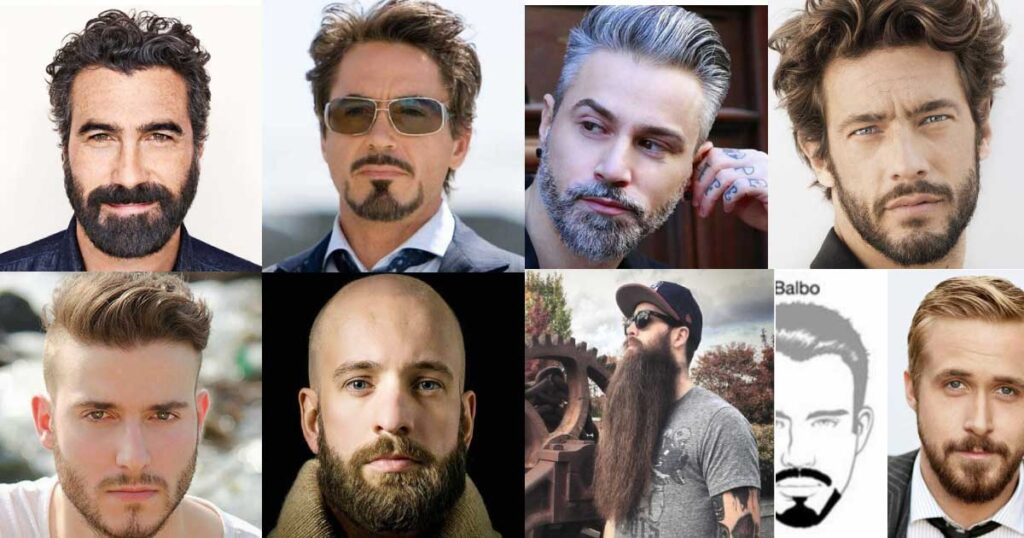
Top Beard Styles for Men (Quick List)
- Stubble (5 o’clock shadow): low maintenance, works on almost every face
- Short boxed beard: clean, even, and office-friendly
- Corporate beard: a slightly fuller, polished take on the short boxed beard
- Goatee: chin-focused coverage that suits patchy cheeks
- Circle beard: mustache and goatee joined in a ring
- Van Dyke: pointed chin beard with a separate mustache
- Anchor beard: pointed chin and jawline strip with a floating mustache
- Balbo: floating mustache over a trimmed chin section
- Chin strap: a narrow line that traces the jaw
- Soul patch: a small tuft below the lower lip
- Beardstache: a prominent mustache over short stubble
- Hollywoodian: full jaw and chin coverage with no sideburns
- Full beard: bold, classic, full-face coverage
- Mutton chops: heavy sideburns with a clean chin
- Ducktail: longer growth tapered to a point
- Garibaldi: wide, rounded, and full
- Verdi: rounded full coverage with a styled, separate mustache
- Viking beard: long, dense, and rugged
- Bandholz: long, natural, and mostly unshaped
- French fork: chin hair split into two points
- Imperial: upturned mustache with a narrow chin tuft
How to Choose the Right Beard Style
- Short on time? Go for stubble or a short boxed beard
- Patchy cheeks? Choose a goatee, Van Dyke, or Balbo
- Strong, even growth? Try a full beard or ducktail
- Professional setting? Stick with a short boxed or corporate beard
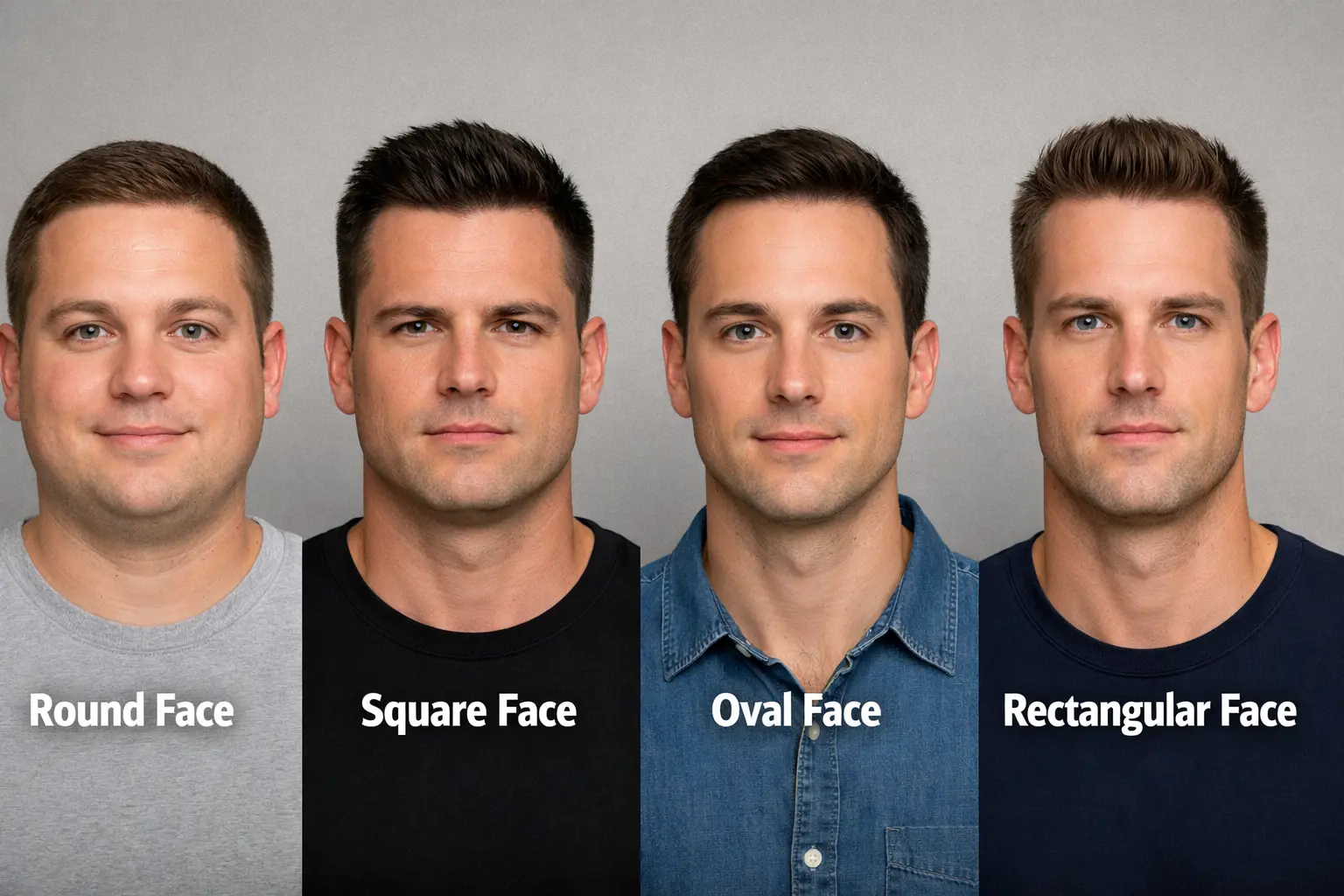
How to Find Your Face Shape
- Round: length and width are similar, with a soft, curved jaw
- Square: length and width are similar, with a sharp, angular jaw
- Oval: longer than it is wide, with a gently rounded jaw
- Rectangular (oblong): clearly longer than wide, with forehead, cheeks, and jaw at similar widths
- Heart: widest at the forehead, narrowing to a pointed chin
- Diamond: widest at the cheekbones, with a narrow forehead and chin
- Triangle: widest at the jaw, narrowing toward the forehead
Best Beard Styles by Face Shape
Your face shape is the most important factor when comparing beard styles. The right beard shapes add definition, soften hard angles, or create balance where your face needs it most.
| Face shape | Goal | Best styles | Go easy on |
|---|---|---|---|
| Round | Add length and angles | Goatee, Van Dyke, short boxed, Balbo | Wide, bulky cheeks |
| Square | Soften the jaw while showing it off | Circle beard, Royale, classic goatee, anchor | Boxy, flat-bottomed shapes |
| Oval | Keep the natural balance | Stubble, chevron with stubble, full beard, short boxed | Very long styles |
| Rectangular | Add width, limit length | Mutton chops, wide Garibaldi or Verdi, short boxed, beardstache | Ducktail, French fork |
| Heart | Add weight at the jaw | Full beard, Garibaldi, short boxed, Hollywoodian | Pointed or chin-only styles |
| Diamond | Fill out a narrow chin and jaw | Full beard, Balbo, circle beard | Mutton chops, sharp points |
| Triangle | Balance a wide jaw | Stubble, beardstache, short boxed with tight sides | Wide full beards, mutton chops |
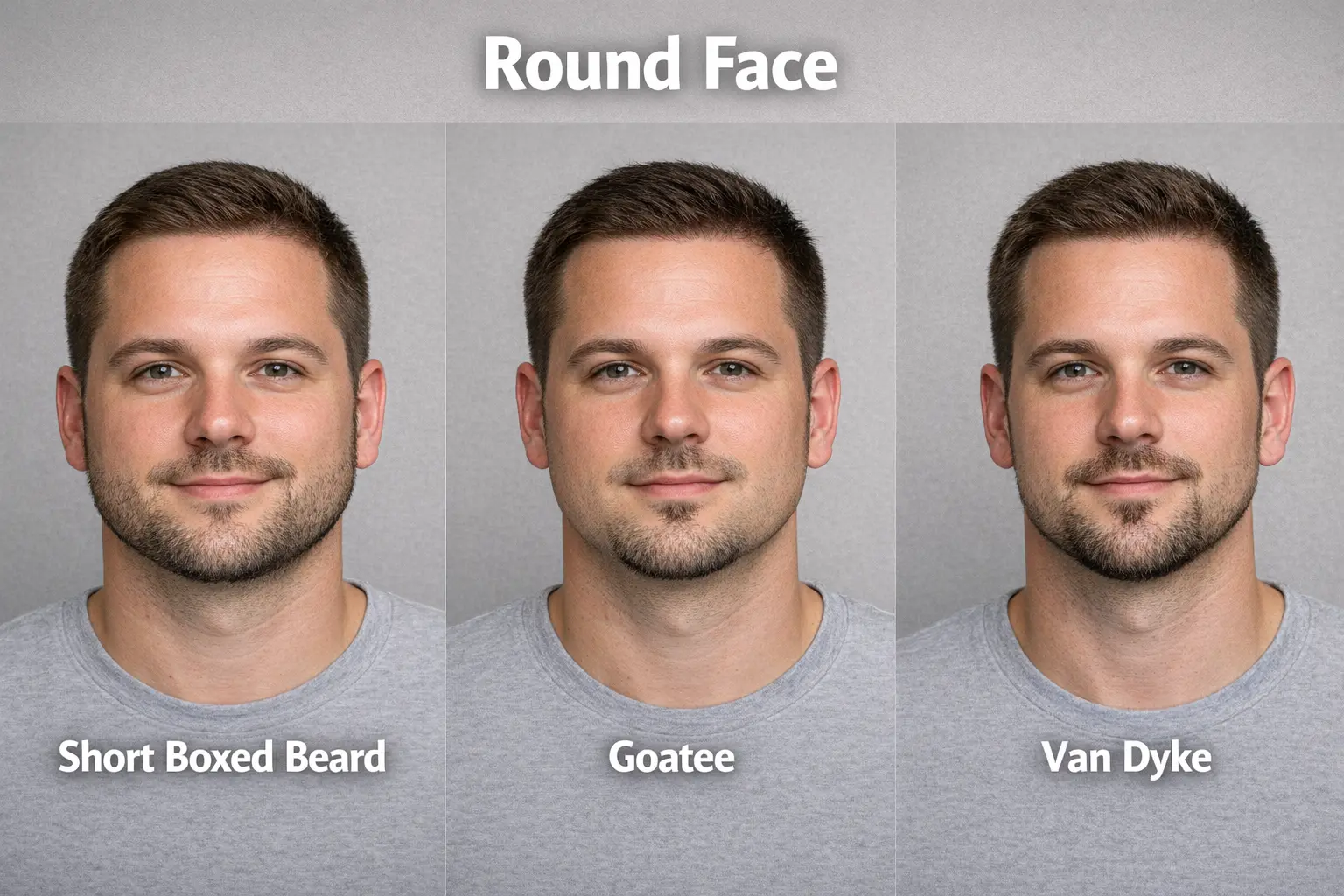
Round face
Goal: Add definition and length to reduce the appearance of width.
- Goatee: keeps volume at the chin, which adds the illusion of length
- Van Dyke: the pointed chin draws the eye downward
- Short boxed beard: neatly trimmed sides reduce width while adding structure
- Balbo: the disconnected mustache focuses attention on the center of the face
Avoid very wide or full styles that add bulk to the sides. Keep cheek lines tight and let the chin carry the volume.
Square face
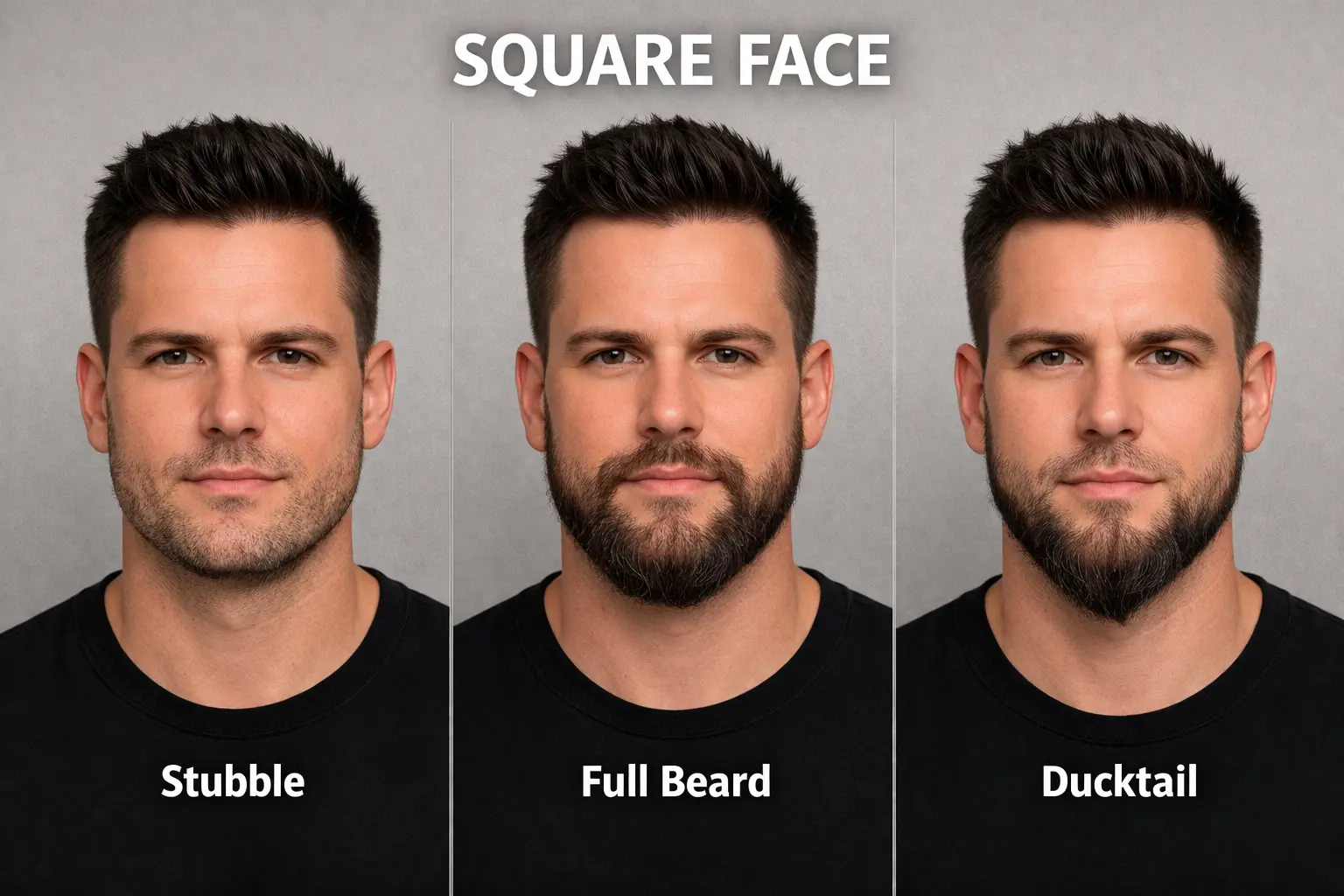
Goal: Show off the jawline while softening sharp angles.
- Circle beard (connected goatee): the rounded shape softens a hard jaw
- Royale: a slim chin beard with a separate mustache that adds length without widening
- Classic goatee: chin-only coverage elongates the jaw naturally
- Anchor beard: traces the jawline for a polished, defined look
Keep the sides short and the chin slightly fuller. Sharp, precise cheek lines suit the natural structure of a square face.
Oval face
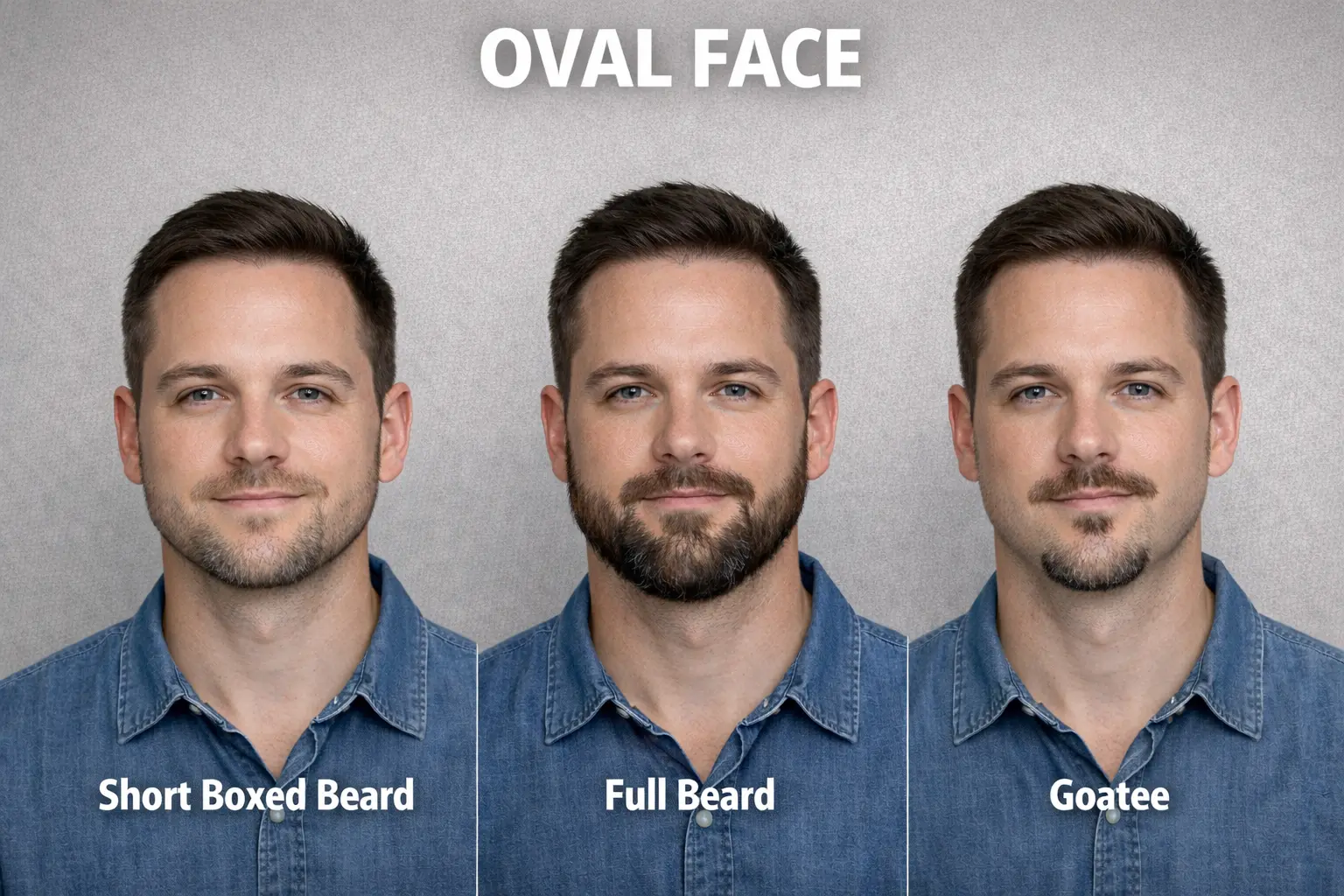
Goal: Maintain balance, since oval faces can pull off most styles.
- Stubble (5 o’clock shadow): works universally and is the easiest to maintain
- Chevron mustache with stubble: a classic pairing with no wrong answer
- Full beard: oval faces carry more volume without looking unbalanced
- Short boxed beard: clean, versatile, and always appropriate
Experiment freely and pick based on your lifestyle rather than shape correction.
Rectangular face
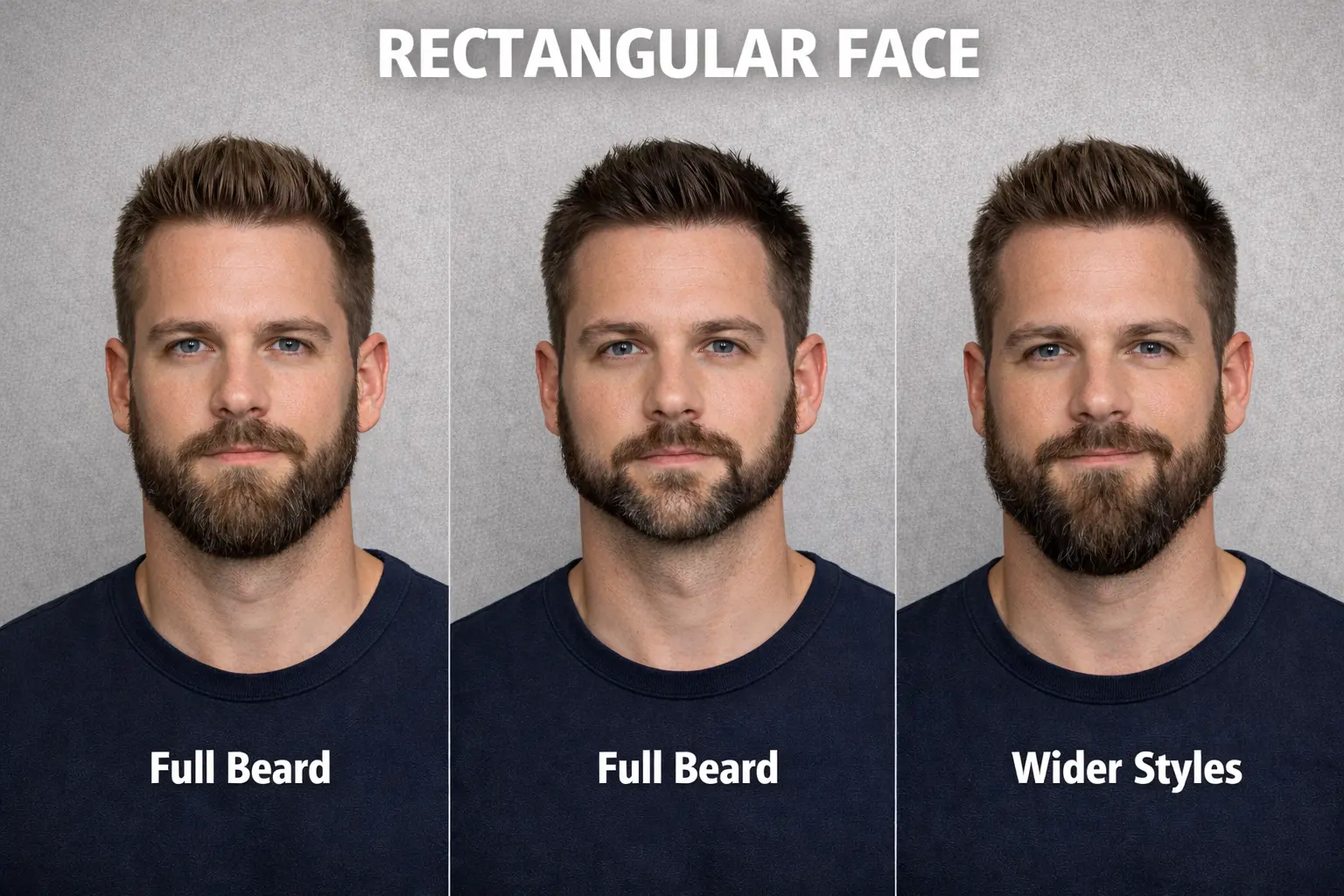
Goal: Reduce length and add width to the sides.
- Mutton chops: long sideburns fill in the sides for a wider appearance
- Garibaldi or Verdi kept wide: a rounded bottom works if the shape stays wider than it is long
- Short boxed beard with fuller sides: keeps width where you need it
- Beardstache: a full mustache adds horizontal width across the middle of the face
Keep the bottom shorter and the sides fuller. Skip styles that add chin length, like the ducktail or French fork.
Heart face
Goal: Add weight along the jaw to balance a wider forehead.
The full beard, Garibaldi, short boxed beard, and Hollywoodian all build volume at the jaw. Avoid pointed or chin-only styles like the ducktail or Van Dyke, which narrow the chin even further.
Diamond face
Goal: Fill out a narrow chin and jaw without widening the cheekbones.
A full beard kept trim on the upper cheeks, a Balbo, or a circle beard adds presence where a diamond face is narrowest. Go easy on mutton chops, which widen the cheekbone area, and on sharply pointed shapes.
Triangle face
Goal: Reduce visual width at the jaw and add presence higher on the face.
Stubble or a beardstache draws attention upward, and a short boxed beard works if the sides stay tight. Avoid wide full beards and mutton chops, which add bulk at the corners of the jaw.
Beard Styles by Length
Length is the second filter after face shape. It sets your timeline, how often you trim, and how much product you’ll need. Guard numbers refer to standard clipper guards, and sizes vary slightly by brand.
Short Beard Styles
Short styles stay at or under about an inch and take up to six weeks to grow. Most of the face sits at guards #1 to #4 (roughly 3 to 13 mm), with chin styles like the goatee and Van Dyke left slightly longer. They pass almost any dress code, and small patches read as shadow at this length. Options include stubble, the short boxed and corporate beards, the circle beard, the goatee, and the Van Dyke.
Medium Beard Styles
Medium beard styles sit between about half an inch and three inches, which usually takes one to four months. This is where shape starts to show: the full beard and the Hollywoodian both live here. Plan on weekly cleanup of the neckline and cheek line.
Long Beard Styles
Long beard styles go beyond about three inches and can take three months to a year or more. The ducktail, Garibaldi, Verdi, Viking beard, Bandholz, and French fork need even density, regular conditioning, and a comb or boar bristle brush to prevent tangles. Have a barber set the first shape, then maintain it at home.

Best Beard Styles for Mature & Professional Men
Men over 40, or anyone in a client-facing role, usually look best in well-groomed styles that read clean and intentional:
- Short boxed beard: a balance of structure and polish
- Anchor beard: stylish and great for defining the jawline
- Corporate beard: neat, low profile, and office-appropriate
- Verdi: a refined, rounded option for men with full growth
Going clean-shaven is always an option too, and it never loses relevance. Crisp lines keep incoming gray looking deliberate.
Beard Styles for Thin Beards & Patchy Growth
Not all men can grow full coverage, but these styles work well when cheek growth is uneven or sparse:
- Soul patch: a small but deliberate option that avoids the cheeks entirely
- Van Dyke: draws attention to defined areas rather than patchy spots
- Goatee: keeps growth focused on the chin, where most men have density
- Balbo: a disconnected mustache and clean cheeks keep attention away from uneven growth
- Heavy stubble: at a few millimeters, gaps read as shadow instead of bare skin
- Faded sides: tapering the sideburns and upper cheeks makes thinner growth look planned
Consider using beard oil and maintaining a proper skincare routine, or explore a beard growth cream to support thicker and more even facial hair.
Facial Hair Styles for Younger Men
Younger men tend to prefer lighter styles with more flexibility. Light stubble, short goatees, and short boxed beards are the most common starting points. Men with strong growth often experiment with the ducktail or Viking beard, while those with patchy cheeks gravitate toward defined goatee styles or a Balbo.
Modern Beard Design Trends
Barbers now offer patterns, sharp lines, and fades that go beyond basic trimming and add a custom finish to almost any style. These techniques highlight the jawline and cheekbones and work best on shorter cuts, where precise edges are most visible.
Popular Beard Styles & Their Names
Here are 21 popular beard styles with what each one looks like, who it suits, and how to shape it. The comparison table below the profiles also shows which ones work with patchy growth.
Stubble
Stubble covers everything from a crisp 5 o’clock shadow to heavier, scruffy growth of about a week. Kept even with a trimmer, it adds shadow and definition to the jaw with almost no styling, which is why it’s the most common starting point.
Growth time: 2 to 7 days | Length: 1 to 5 mm | Upkeep: Low | Best for: All face shapes
How to shape it: Trim the whole area to one short setting every two to three days, and keep the neckline defined so the look reads as intentional.

Short Boxed Beard
A short style that covers the jawline, chin, and mustache area with neatly trimmed, defined edges. It works in professional environments while still feeling personal, and it suits most face shapes with moderate effort.
Growth time: 2 to 4 weeks | Length: About 1/4 to 1/2 inch (guards #2 to #4) | Upkeep: Moderate | Best for: All face shapes
How to shape it: Trim to one even length, set a clean cheek line, fade the sideburns into the rest, and place the neckline one to two finger-widths above the Adam’s apple.
Corporate Beard
Neat, balanced, and conservative. The corporate beard is a slightly longer short boxed beard with a gently rounded bottom, kept at a controlled length that reads professional in formal settings.
Growth time: 3 to 5 weeks | Length: About 3/8 to 5/8 inch | Upkeep: Moderate | Best for: All face shapes
How to shape it: Keep the sides one guard shorter than the chin, round off the bottom, and keep the mustache clear of the upper lip.
Goatee
In its classic form, a goatee keeps hair on the chin only. Add a mustache and it becomes a circle beard or a Van Dyke, depending on whether the two connect. Because it skips the cheeks, it’s ideal for men with patchy beards.
Growth time: 2 to 6 weeks, depending on length | Length: Stubble to about 1 inch | Upkeep: Moderate | Best for: Round, square, and oval faces
How to shape it: Outline the chin area evenly on both sides, shave everything outside it every two to three days, and trim the goatee weekly.

Circle Beard
A mustache connected to a rounded chin beard, forming a neat ring around the mouth. Its round outline softens an angular jaw while staying tidy enough for almost any workplace.
Growth time: 2 to 4 weeks | Length: About 1/4 to 1/2 inch | Upkeep: Moderate | Best for: Square, oval, and diamond faces
How to shape it: Outline a rounded shape from the mustache around the corners of the mouth and under the chin, then shave everything outside that line.
Van Dyke Beard
Named after the 17th-century Flemish painter Anthony van Dyck, who wore it in his self-portraits, the Van Dyke pairs a pointed chin beard with a mustache that never touches it. The clean gap at the corners of the mouth is the signature detail, and the point adds length to a round face.
Growth time: 4 to 6 weeks | Length: About 1/2 to 1 inch at the chin | Upkeep: Moderate | Best for: Round, oval, and square faces
How to shape it: Shave the cheeks, jaw, and neck, trim a clean break between the mustache and chin on both sides, and taper the bottom to a gentle point.
Anchor Beard
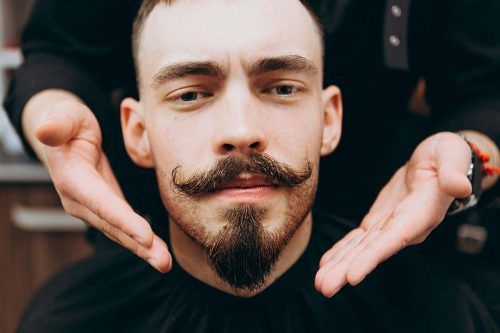
The anchor combines a pointed chin beard that runs along the lower jaw, a soul patch, and a separate mustache, together resembling a ship’s anchor. Unlike the Van Dyke, which stays on the chin, it extends along the jawline for more structure.
Growth time: 4 to 6 weeks | Length: About 1/4 to 1/2 inch | Upkeep: High | Best for: Round, square, and oval faces
How to shape it: Leave a narrow strip along the lower jaw that widens to a point at the chin, keep the soul patch, and touch up the gaps every two to three days.
Balbo
Named after Italian aviator Italo Balbo, this style pairs a floating mustache with a chin section that extends slightly along the jaw, with no sideburns and clean cheeks. Because it avoids the cheeks on purpose, it’s one of the best options for patchy growth.
Growth time: 4 to 6 weeks | Length: About 1/4 to 1/2 inch | Upkeep: Moderate | Best for: Round, oval, and diamond faces
How to shape it: Shave the cheeks, sideburns, and neck, then leave a small gap at each corner of the mouth to separate the mustache from the chin section.
Types of Goatee Styles
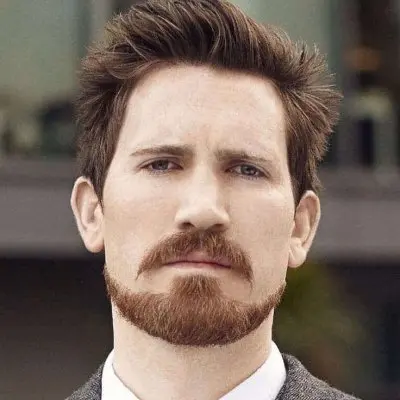
Most goatee styles are variations on one idea: keep the density on the chin, then decide what happens with the mustache and jaw. The circle beard, Van Dyke, anchor, and Balbo above are the main variants. Two more are worth knowing:
- Royale: a slim chin beard with a separate mustache, kept narrow to add length without width
- Shadow goatee: any goatee worn with light stubble on the cheeks to soften contrast and hide patchy areas
Pointed versions like the Van Dyke and anchor add the most length to a round face, while the rounded circle beard softens a square jaw.
Chin Strap
A thin band of hair that follows the jawline from sideburn to sideburn, with no mustache and clean cheeks. It frames the jaw sharply, and darker, denser hair makes the line easier to see.
Growth time: 1 to 2 weeks | Length: About 3 to 5 mm | Upkeep: High | Best for: Square and oval faces
How to shape it: Keep the band an even width along the jawbone and edge it with a trimmer.
Soul Patch
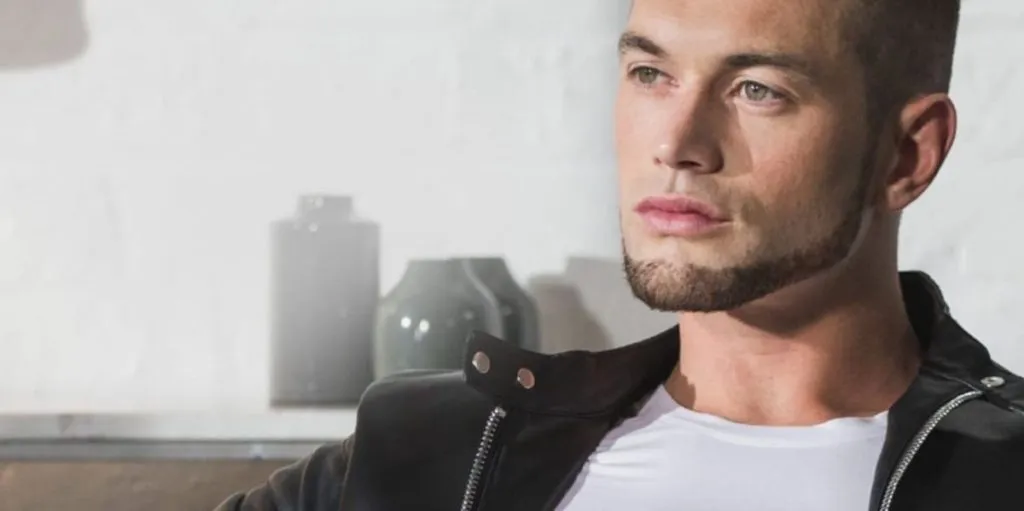
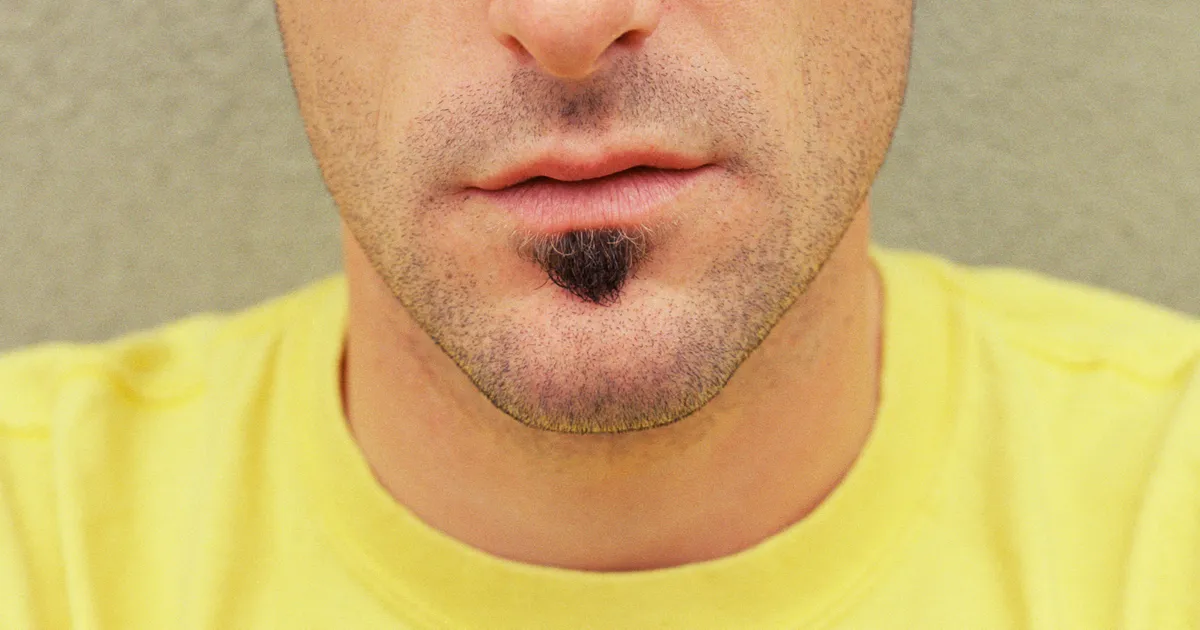
A small, deliberate tuft directly below the lower lip. Associated with 1950s and 1960s jazz culture, it works alone or as a finishing detail on the anchor.
Growth time: 1 to 2 weeks | Length: Up to about 1/2 inch | Upkeep: Low to moderate | Best for: All face shapes
How to shape it: Shave everything except a small area under the center of the lower lip, keeping it narrower than your mouth.
Beardstache
The beardstache reverses the usual balance: a full, prominent mustache sits over short stubble. The contrast pulls attention to the center of the face, and it’s a smart choice when your mustache grows in thicker than your cheeks.
Growth time: 4 to 8 weeks for the mustache | Length: Stubble plus a full mustache | Upkeep: Moderate | Best for: Rectangular, triangle, and oval faces
How to shape it: Keep the rest of the face at stubble length and trim the mustache only along the lip line.
Hollywoodian
Full coverage on the jaw and chin with a connected mustache but no sideburns, leaving a clean gap in front of each ear. It keeps visual weight along the jaw, which balances a heart-shaped face, and it forgives slow growth near the ears.
Growth time: 4 to 6 weeks | Length: About 1/2 to 1 inch | Upkeep: Moderate | Best for: Heart, round, and oval faces
How to shape it: Shave a clean line from the bottom of each sideburn down to the jaw, then trim the rest to an even length.
Full Beard
A classic statement look and the reference point for most thick beard styles. Full coverage spans the cheeks, chin, jaw, and upper neck, and it needs the most consistent density on this list, plus regular washing, conditioning, trimming, and oil.
Growth time: 2 to 4 months | Length: About 1 to 3 inches | Upkeep: Moderate to high | Best for: Oval, heart, and diamond faces, and rectangular faces when kept short
How to shape it: Leave everything except the neckline alone for about three months, then even it out and set the cheek line just below your natural growth line.

Mutton Chops
Thick sideburns that grow down the cheeks toward the corners of the mouth, with a clean-shaven chin. Connect the two sides with a mustache and you get “friendly” mutton chops. The extra width helps balance a long face.
Growth time: 6 to 8 weeks | Length: About 1/2 to 1 inch | Upkeep: High | Best for: Rectangular and oval faces
How to shape it: Grow full coverage first, shave the chin and center of the jaw, then shape each side so it widens as it comes down the cheek.
Ducktail
A longer style with shorter sides and a tapered, pointed finish at the chin that resembles a duck’s tail. It needs at least two to four inches of growth and is best shaped the first time by a barber; after that, a trimmer keeps it in line at home.
Growth time: 3 to 5 months | Length: 2 to 4 inches at the chin | Upkeep: Moderate to high | Best for: Round, oval, and square faces
How to shape it: Keep the cheeks and sides shorter than the chin, blend the lengths, and sculpt the bottom into a symmetrical point.
Garibaldi
Named after 19th-century Italian general Giuseppe Garibaldi, this is wide, full coverage with a rounded bottom and a neatly trimmed mustache that blends into it. The rounded finish is what separates it from a scraggly, overgrown look.
Growth time: 4 to 6 months | Length: About 3 inches or more | Upkeep: Moderate | Best for: Oval, square, and heart faces, and rectangular faces when kept wider than long
How to shape it: Use a brush to train the bottom hair to round outward, and trim only the upper lip so the mustache stays clear of your mouth.
Verdi
Named after 19th-century Italian composer Giuseppe Verdi, the Verdi is shorter and more polished than the Garibaldi. The rounded base usually stays under about four inches, while the mustache is grown out fully and styled to stay visually separate.
Growth time: 4 to 6 months | Length: Up to about 4 inches | Upkeep: Moderate to high | Best for: Oval, square, heart, and rectangular faces
How to shape it: Round off the bottom, keep the cheeks slightly shorter than the jaw, and use a little mustache wax so the ends stay separate.
Viking Beard
Long, dense, and commanding. The Viking look requires significant growth and a commitment to conditioning, since longer hair dries out and tangles without regular oil and brushing. It pairs well with longer hairstyles.
Growth time: 6 to 12 months | Length: 4 inches or more | Upkeep: High | Best for: Oval and square faces
How to shape it: Limit trimming to the neckline and mustache, and use braids or a firm balm once the length gets heavy.
Bandholz
A long, natural, unshaped full beard popularized by Eric Bandholz, founder of Beardbrand. It’s grown out with almost no sculpting, so consistent oil and balm do most of the work of keeping it healthy.
Growth time: 6 to 12 months | Length: Several inches, left natural | Upkeep: Moderate | Best for: Oval, square, and heart faces
How to shape it: Skip the trimmer beyond keeping the mustache out of your mouth, and focus on washing, conditioning, and detangling.
French Fork
Chin hair, sometimes grown into a ducktail shape, that splits into two separate points below the chin. It’s best known today from Captain Jack Sparrow’s braided look in Pirates of the Caribbean.
Growth time: 3 to 5 months | Length: 3 inches or more at the chin | Upkeep: High | Best for: Oval faces
How to shape it: Shave the cheeks and jawline, keep a mustache, and train the chin hair into two sections with a comb and a little wax or balm.
Imperial
The imperial pairs a long, waxed mustache with upturned tips and a narrow tuft of hair below the lower lip, leaving the cheeks and jaw clean. Emperor Napoleon III of France made it famous in the 19th century. It isn’t a practical everyday choice, but few looks are more distinctive.
Growth time: 3 to 6 months, mostly for the mustache | Length: Long mustache with a narrow chin tuft | Upkeep: High | Best for: Oval and rectangular faces
How to shape it: Grow the mustache untrimmed until the ends can curl, shave the cheeks and jaw, and wax the tips upward daily.
All 21 Beard Styles Compared
| Style | Growth time | Length | Upkeep | Patchy-friendly | Best face shapes |
|---|---|---|---|---|---|
| Stubble | 2 to 7 days | 1 to 5 mm | Low | Yes | All |
| Short boxed beard | 2 to 4 weeks | 1/4 to 1/2 in | Moderate | Somewhat | All |
| Corporate beard | 3 to 5 weeks | 3/8 to 5/8 in | Moderate | No | All |
| Goatee | 2 to 6 weeks | Stubble to 1 in | Moderate | Yes | Round, square, oval |
| Circle beard | 2 to 4 weeks | 1/4 to 1/2 in | Moderate | Yes | Square, oval, diamond |
| Van Dyke | 4 to 6 weeks | 1/2 to 1 in | Moderate | Yes | Round, oval, square |
| Anchor beard | 4 to 6 weeks | 1/4 to 1/2 in | High | Yes | Round, square, oval |
| Balbo | 4 to 6 weeks | 1/4 to 1/2 in | Moderate | Yes | Round, oval, diamond |
| Chin strap | 1 to 2 weeks | 3 to 5 mm | High | Somewhat | Square, oval |
| Soul patch | 1 to 2 weeks | Up to 1/2 in | Low to moderate | Yes | All |
| Beardstache | 4 to 8 weeks | Stubble plus full mustache | Moderate | Yes | Rectangular, triangle, oval |
| Hollywoodian | 4 to 6 weeks | 1/2 to 1 in | Moderate | Somewhat | Heart, round, oval |
| Full beard | 2 to 4 months | 1 to 3 in | Moderate to high | Somewhat | Oval, heart, diamond |
| Mutton chops | 6 to 8 weeks | 1/2 to 1 in | High | No | Rectangular, oval |
| Ducktail | 3 to 5 months | 2 to 4 in at chin | Moderate to high | No | Round, oval, square |
| Garibaldi | 4 to 6 months | 3 in or more | Moderate | No | Oval, square, heart |
| Verdi | 4 to 6 months | Up to 4 in | Moderate to high | No | Oval, square, heart, rectangular |
| Viking beard | 6 to 12 months | 4 in or more | High | No | Oval, square |
| Bandholz | 6 to 12 months | Several inches | Moderate | No | Oval, square, heart |
| French fork | 3 to 5 months | 3 in or more at chin | High | No | Oval |
| Imperial | 3 to 6 months | Long mustache, narrow tuft | High | Yes | Oval, rectangular |
Growth times and lengths are typical ranges for most men. Genetics, age, and hormones can move them in either direction.
Beard and Mustache Styles That Work Together
A mustache chosen on purpose makes the whole look read as intentional.
Chevron Mustache
The chevron is a thick, wide mustache that follows the natural line of the upper lip and covers it fully. It pairs well with stubble, a short boxed beard, or light scruffy growth. Popularized by figures like Tom Selleck, it projects a confident, direct appearance. Best for: oval and square face shapes.
Horseshoe Mustache
A bold mustache with long bars that extend downward past the corners of the mouth toward the chin. The horseshoe works best as a standalone style or with very light stubble, and it draws the eye vertically, which adds length to shorter or rounder faces. Best for: oval and rectangular face shapes.
Classic Stache
A neatly trimmed, traditional mustache that sits above the upper lip without extending to the sides. It pairs well with a goatee, the Van Dyke, and the Verdi, and needs only a weekly trim to stay clean. Best for: all face shapes.
Handlebar Mustache
A longer mustache with ends waxed and curled upward, named for its resemblance to bicycle handlebars. It pairs well with a full beard trimmed slightly shorter just under the lip, so the curled ends stand out. Best for: oval and rectangular face shapes.
Beard and Hairstyle Combinations
A haircut that clashes with your facial hair can undercut an otherwise sharp style.
Short, tight fades work well with structured styles like the short boxed beard, anchor beard, and corporate beard. The fade and the clean edge create a continuous, cohesive frame for the face.
Longer hairstyles like a slick back or textured crop work better with fuller styles such as the full beard, Garibaldi, or Viking beard. If you’re wearing a disconnected undercut, a Balbo or Van Dyke adds contrast and keeps the look intentional.
Trending Beard Styles and Celebrity Looks
Celebrity-Inspired Beard Looks
Three well-known looks and why they work:
- Chris Hemsworth
He wears a rugged medium stubble, typically around five to seven days of growth kept even with a trimmer. His strong jawline makes the style look effortless, and the edges stay defined at the neckline and cheeks even though the overall look appears natural.
- Jason Momoa
He wears a bold full beard with a relaxed neckline and natural cheek lines. The width it adds to the sides balances his longer face, and the length carries volume without crossing into Viking territory. Maintenance requires daily conditioning and a wide-tooth comb.
- Idris Elba
He keeps a short, clean look that falls between a corporate beard and a short boxed beard, with edges that are always crisp. His square jaw provides natural structure that the hair simply frames, so it reads professional in a suit and casual in streetwear.
Modern Beard Trends in 2026
The main trends this year:
- Faded beards: blended smoothly into the haircut at the temples and sideburns for a continuous look
- Hybrid styles: combinations like mutton chops with a goatee, or a Balbo with heavier stubble on the cheeks
- Minimalist beards: short, sharp, and well-defined, with clean necklines and precise edges
- Textured stubble: longer than a 5 o’clock shadow but shorter than a short boxed beard, kept intentionally uneven for a lived-in look
Growing and Maintaining Your Beard
The 3-Month Beard Rule Explained
The 3-month rule suggests letting your facial hair grow for at least 90 days before shaping it, so you can see its full potential. Density and growth pattern only become clear after consistent growth, and trimming too early means deciding based on incomplete information.
The rule also has a biological basis. Androgens keep enlarging facial hair follicles and the hairs they produce for years after puberty, so density often continues to improve well into adulthood (FASEB Journal, via PubMed Central).
What Is the Rule 5 for Beards?
There’s no official standard, but the “rule of 5” that circulates in grooming circles usually refers to five habits:
- Trim regularly.
- Use beard oil for hydration.
- Wash at least 2 to 3 times a week.
- Keep the neckline neatly trimmed.
- Choose a style that complements your face shape and hairstyle.
Essential Beard Care Routine
For healthy facial hair, follow these steps consistently:
- Use a mild beard shampoo, not regular hair shampoo
- Apply beard oil to keep hair soft and hydrated
- Trim with a quality trimmer to hold your beard cut style between barber visits
- Exfoliate your skin to prevent beard dandruff.
Best Oils & Products for Beard Growth
Top products for better beard growth and grooming include:
- Beard oil: hydrates hair and skin, reducing itchiness and brittleness
- Beard balm: adds control and volume, useful for longer styles
- Beard growth cream: applied to sparse areas as part of a daily routine
- Boar bristle brush: distributes natural oils evenly and trains growth direction
Daily oil is the easiest habit to keep. Oils and balms improve how existing hair looks and feels, but they don’t create new follicles.
Beard Styles by Hair Type
- Straight hair holds clean lines well, which makes structured styles like the short boxed beard, Van Dyke, and anchor easy to maintain.
- Wavy hair works well with fuller styles where some natural movement is an asset, like the full beard, Garibaldi, or ducktail. Balm keeps the shape consistent.
- Coarse or curly hair is denser and dries out more easily. Shaving it close can cause razor bumps as curved hairs grow back into the skin (American Academy of Dermatology), so an even short length, like a short boxed or full beard, is often more comfortable than razor-sharp lines. Outline goatees and chin straps with a trimmer rather than a blade, and treat daily oil as non-negotiable.
Common Beard Problems and Solutions
Why Is My Beard Patchy?
Patchy growth most often comes down to genetics. Facial hair follicles respond to androgens such as testosterone and dihydrotestosterone (DHT), and how strongly each follicle responds is largely inherited (Experimental Dermatology). That’s why two men with normal hormone levels can grow very different beards.
Dermatologists confirm that your genes determine whether you develop thin, sparse areas (American Academy of Dermatology). The most practical solutions are:
- Let it grow before you judge it, since many patches fill in over the first two to three months.
- Use beard oil to keep skin and hair moisturized, which can make sparse areas look slightly fuller.
- Choose styles that work with your density rather than fighting it, such as a goatee or Van Dyke.
Patches that look different deserve a closer look. Smooth, round bald spots that appear suddenly, often along the jawline, can be a sign of alopecia areata, an autoimmune condition that affects the beard area (American Journal of Clinical Dermatology). If you’ve noticed uneven patches or thinning areas, learn more about possible causes in our guide on Alopecia Barbae: Causes, Symptoms, and Treatments.
When Styling Isn’t Enough
Styling can hide a lot, but it can’t add follicles where none exist. A medical evaluation makes sense if patches haven’t changed after three or more months, if bald spots appear suddenly, or if scarring from acne, injury, or surgery has left areas where hair doesn’t grow.
For men with stable, genetic sparseness, a beard transplant moves individual follicles from a donor area, such as under the chin or the scalp, into the areas that need density (International Society of Hair Restoration Surgery).
Grafts are planned around the style the patient wants to wear, because a goatee, a short boxed beard, and full coverage each need density in different places. Transplanted hair takes several months to grow in; our beard transplant timeline explains each stage, and you can see real beard transplant before and after results.
Beard Dandruff & How to Prevent It
Flaky skin under facial hair is common and manageable. Dryness plays a role, but persistent flakes with redness, itching, or greasy scale are usually seborrheic dermatitis, which often develops under a beard or mustache (American Academy of Dermatology).
Solutions include:
- Wash with a mild beard cleanser, not regular shampoo, which strips too much natural oil. For stubborn flakes, switch to a medicated wash on the area.
- Apply a light beard oil daily to moisturize the skin beneath the hair.
- Brush daily to lift dead skin cells and distribute oil evenly.
If flakes don’t improve after a few weeks of consistent care, see a dermatologist.
Neckline and Cheek Line Problems
A poorly defined neckline is one of the most common grooming mistakes. It should sit one to two finger-widths above the Adam’s apple and follow a gentle curve from ear to ear. Set it too high and the shape looks disconnected; set it too low and it looks unkempt.
Cheek lines that are too high remove natural coverage and make the shape look narrow. Trim them to sit just below your natural growth line rather than cutting far into the cheek.
Uneven Growth
If one side grows noticeably faster than the other, trim to the shorter side rather than trying to compensate. Most mild asymmetry evens out visually once the hair has more length. If one area stays sparse after several months, it’s worth having it evaluated.
Beard Troubleshooting: If-Then Solutions
- If your beard has patchy growth: Opt for stubble, a goatee, or a Balbo. These styles minimize uneven areas and still look deliberate.
- If your beard looks too heavy or bulky: Fade the neckline and tighten the cheek lines. You don’t need to lose length, just define the edges.
- If dryness or itchiness occurs: Increase oil frequency and add a balm for extra moisture, particularly in dry or cold climates.
- If your beard feels unruly: Comb daily, use balm for hold, and trim flyaways with a trimmer rather than scissors to keep length consistent.
- If your neckline keeps looking off: Pick a fixed reference point, such as one to two finger-widths above the Adam’s apple with your head level, and use it every time you trim.
- If beard dandruff keeps returning: Switch to a medicated wash and add gentle daily brushing; if it persists, see a dermatologist.
Beard Styles FAQ
Which beard style suits my face shape best?
Square faces work well with goatee styles and circle beards, while round faces benefit from styles that add chin length, like the Van Dyke or anchor beard. Oval faces can carry almost any style, and rectangular faces look more balanced with fuller sides, like mutton chops or a wide Garibaldi. Heart faces need weight at the jaw, diamond faces need a fuller chin, and triangle faces look best with tight sides.
What is the easiest beard style to maintain?
Stubble and the short boxed beard require the least upkeep. Both need a trim every few days to a week, but neither demands much product or shaping skill.
What beard types work best for patchy growth?
A goatee, Van Dyke, Balbo, or soul patch all avoid the cheeks, where patchiness is most common. These styles focus density on the chin and upper lip, where most men grow more consistently.
How do I choose between short and full beard styles?
Consider your daily maintenance tolerance and your face shape first. Short styles are easier to keep sharp and work in most professional settings, while full beard types make a stronger statement but need daily conditioning, regular washing, and more frequent shaping.
What beard style works for men over 40?
A short boxed beard, anchor beard, corporate beard, or Verdi all read polished at any age. Clean lines matter more than length at this stage.
Can I mix beard and mustache styles?
Yes. A chevron mustache pairs well with stubble or a short boxed beard, a Van Dyke pairs a pointed chin with a detached mustache, and a Verdi uses a full, separated mustache with a rounded base. Mixing works best when the two elements are clearly defined, not blended.
What is the most attractive beard style?
Research points to heavy stubble. In a 2013 study by Dixson and Brooks in Evolution and Human Behavior, women rated faces with about 10 days of growth as the most attractive, while full beards scored highest for perceived health and parenting ability (Psychology Today). In practice, the most attractive style is the one that fits your face and stays well groomed.
How long does it take to grow a full beard?
Most men need two to four months for a full beard with enough length to shape, and three to six months or more for longer styles like the ducktail or Garibaldi. Growth rate and density vary with genetics and age.