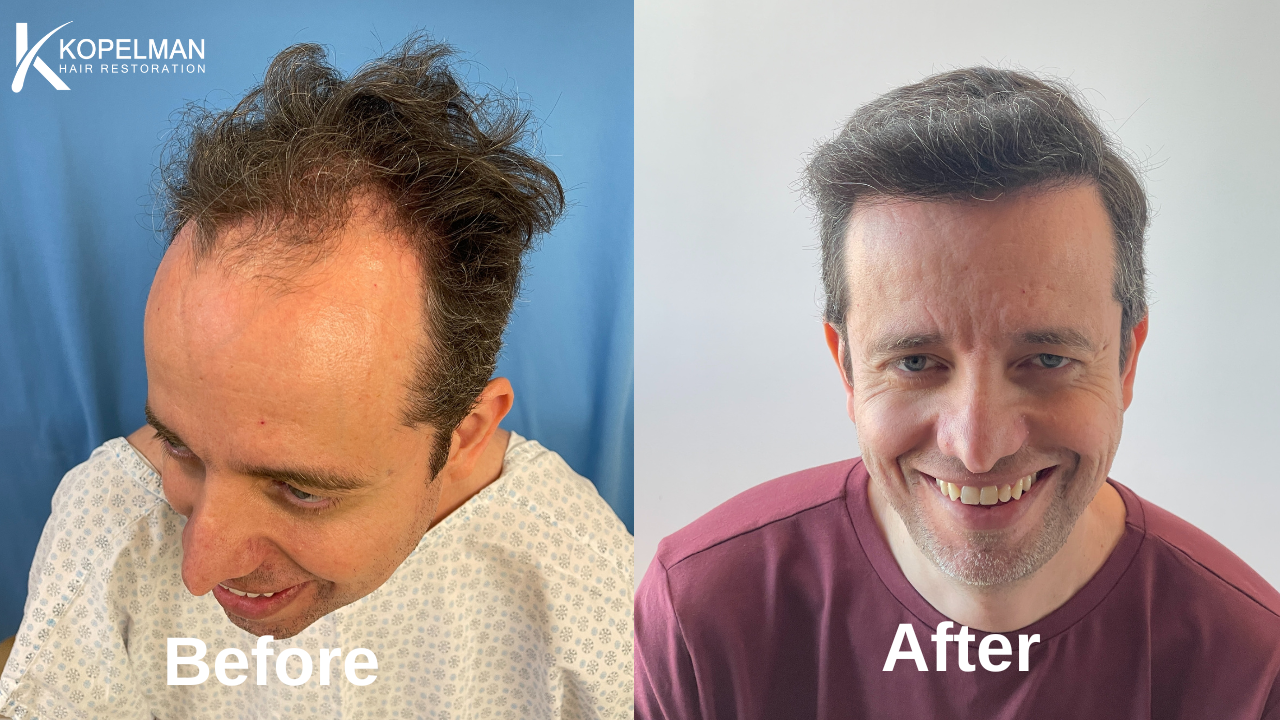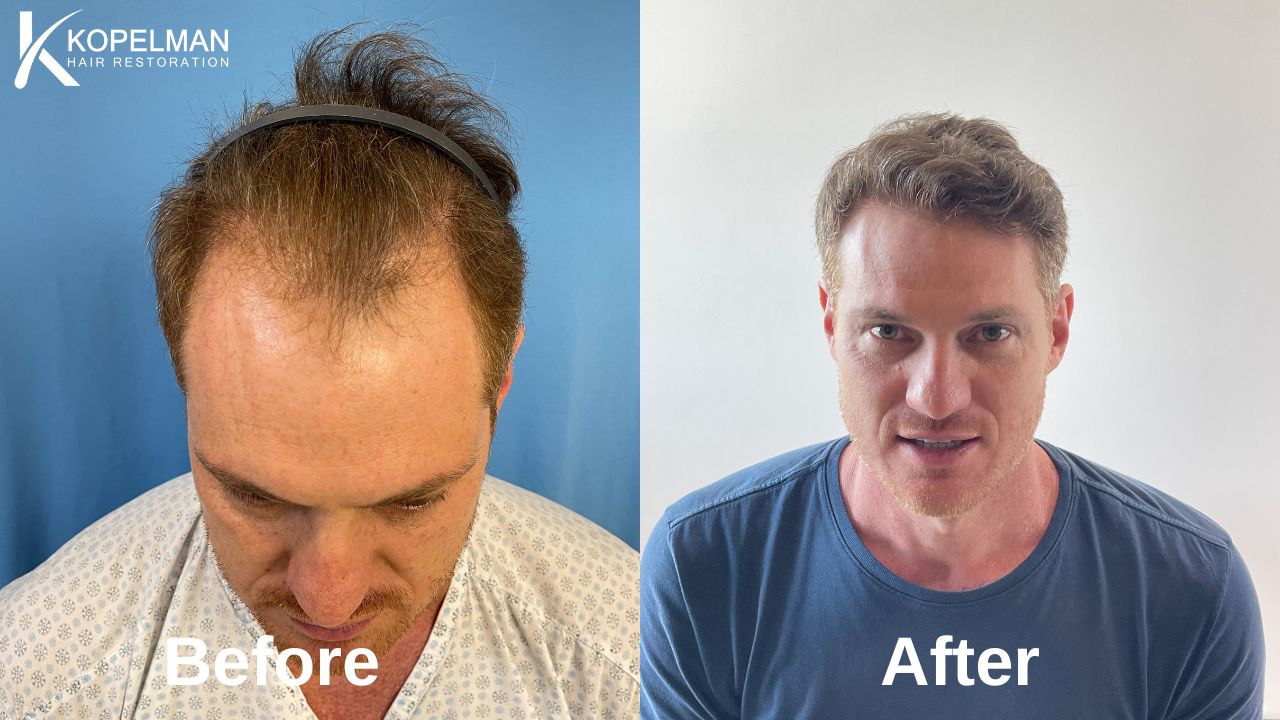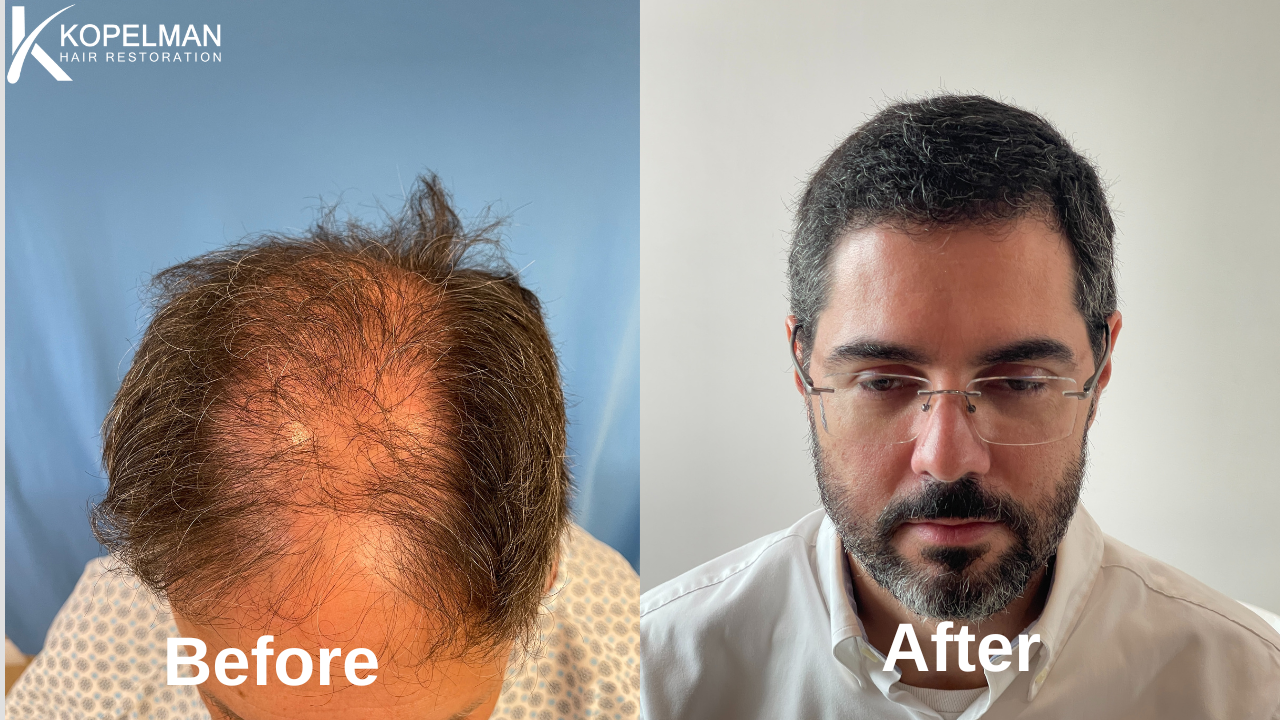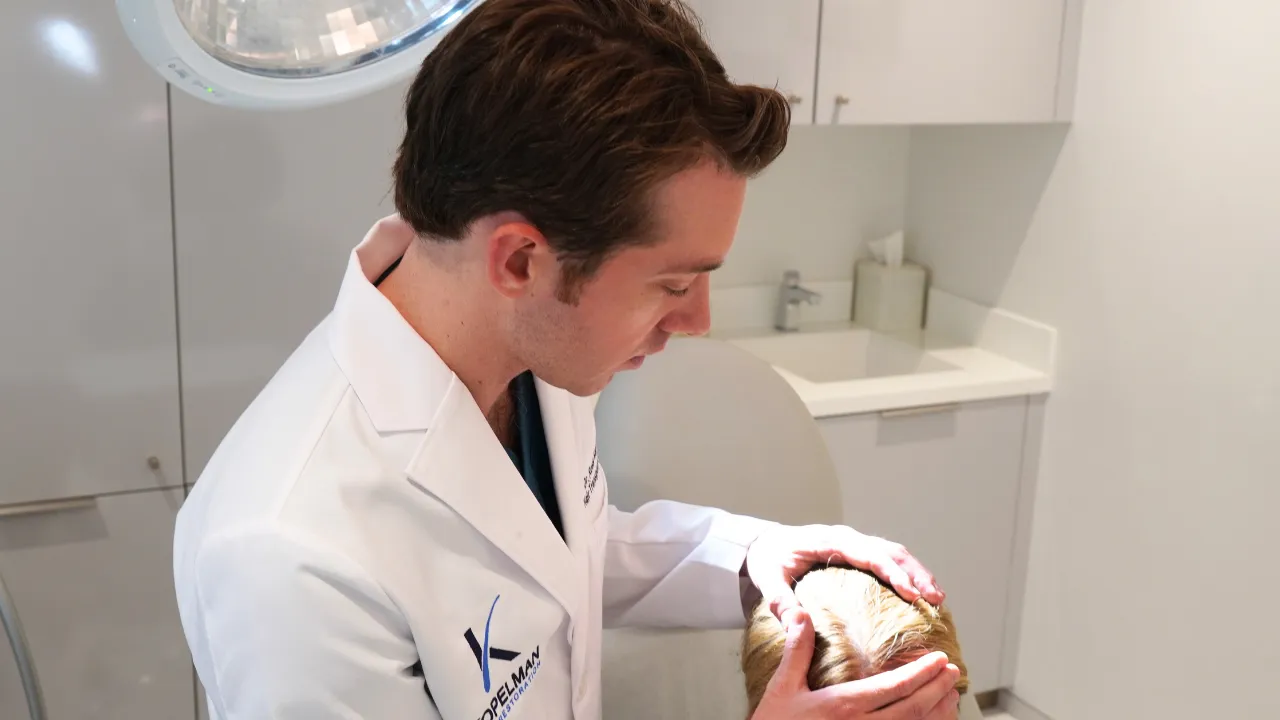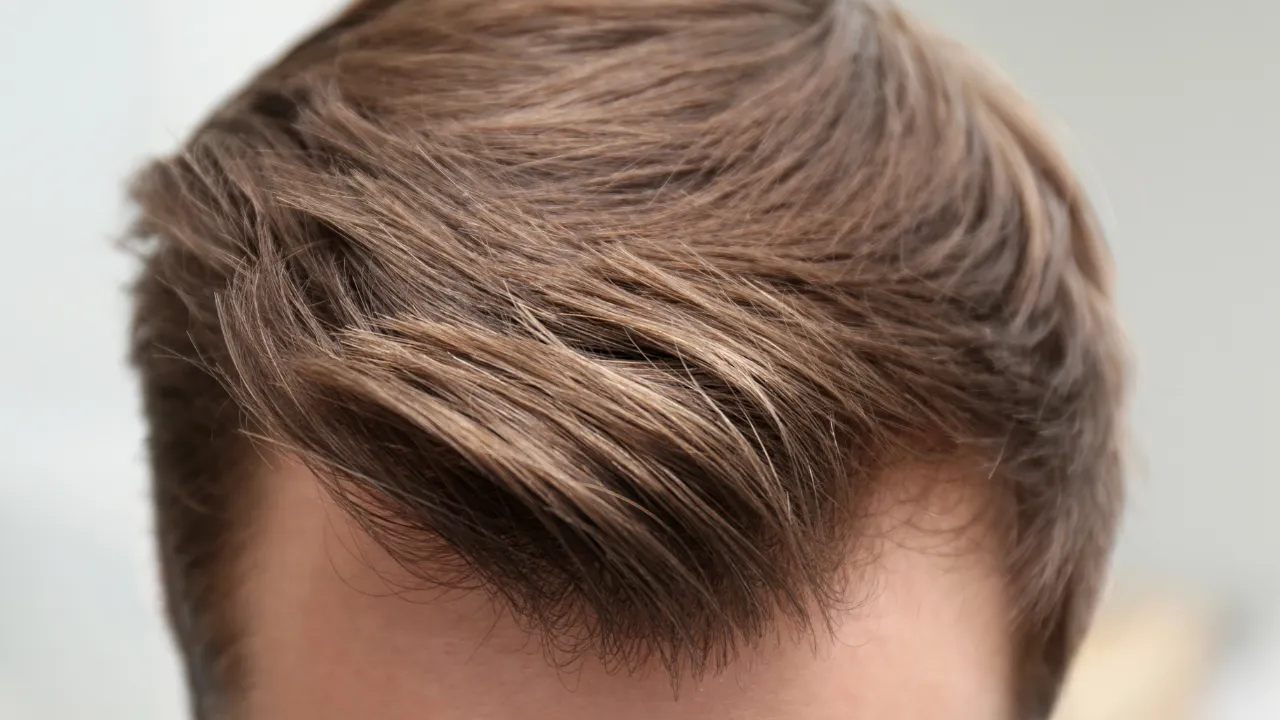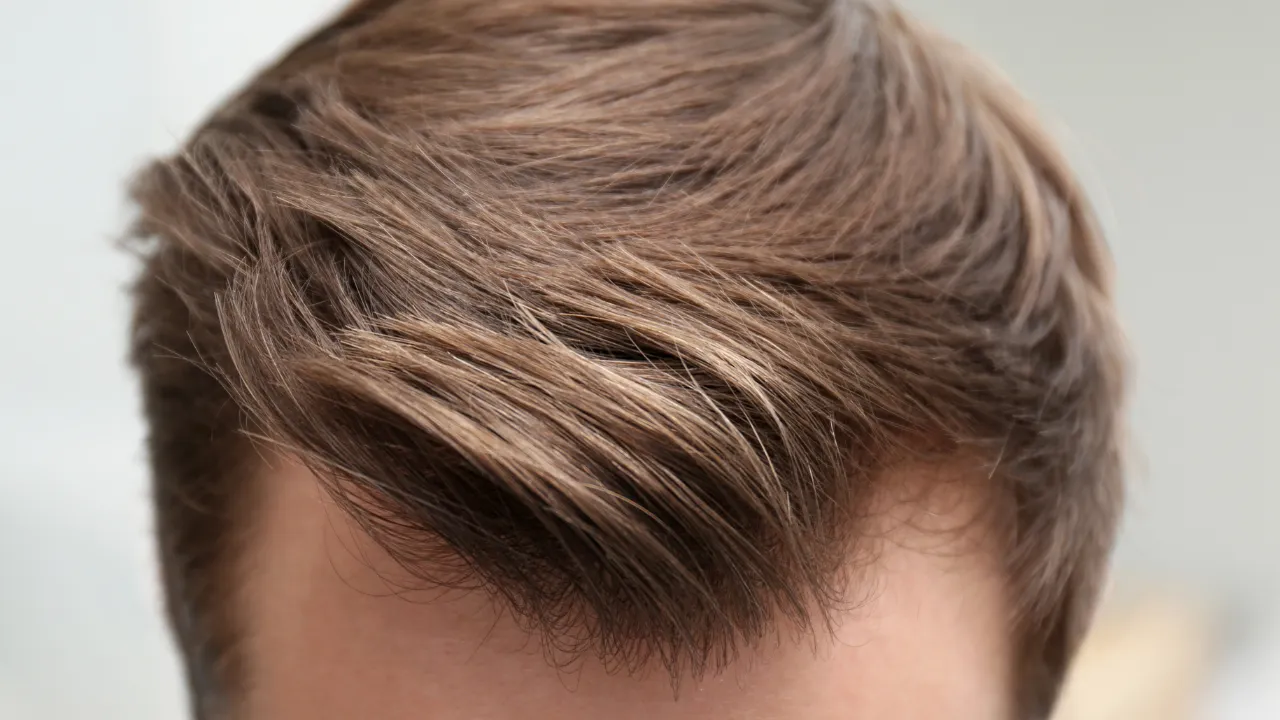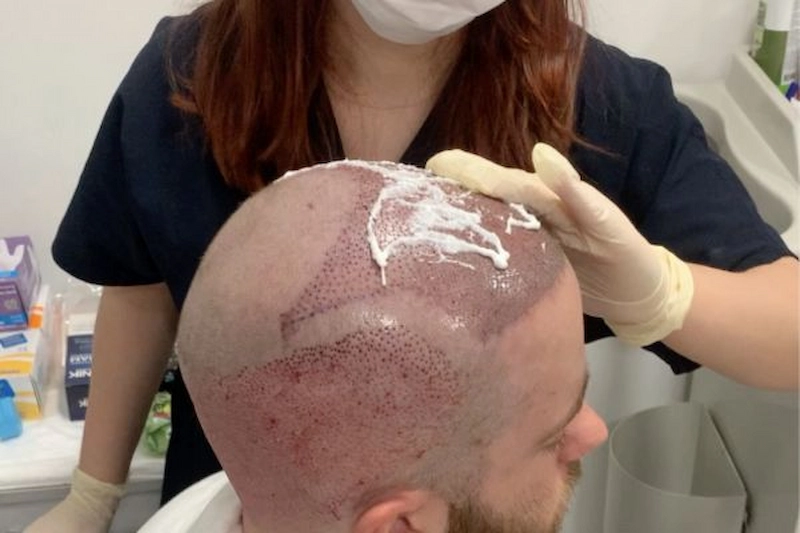
At Kopelman Hair, the frontal edge is mapped through a personalized process tailored to facial structure and long-term goals.
Dr. Kopelman focuses on natural, age-appropriate results that blend seamlessly with existing growth. This helps ensure the outcome looks believable both immediately and years later.
The Anatomy of a Natural Frontal Edge
A believable result is not one flat line; it is an extended zone roughly 2 to 3 cm deep that bridges the bare forehead to the denser scalp behind it.
Surgeons typically plan it in three connected zones, a structure documented in the clinical literature on frontal restoration (Shapiro & Shapiro, peer-reviewed{rel=”nofollow”}).
The transition zone is the most forward strip, kept soft, irregular, and slightly see-through. The defined zone sits just behind it and carries more density and definition.
The frontal tuft, a small oval at the center, holds the highest concentration of grafts and drives the impression of fullness.
Two side landmarks matter just as much. The frontal-temporal angle is where the front line meets the temple; flattening or overfilling it is a common error that reads as artificial.
The temporal points, the small triangular protrusions near the temples, frame the face and prevent the forehead from looking wider than it should.
| Zone | Role | Graft type used | Relative density |
|---|---|---|---|
| Transition zone (front 0.5 to 1.0 cm) | Soft, irregular, slightly see-through leading edge | Single-strand grafts | Lowest |
| Defined zone | Adds substance and definition behind the front | Mostly two-strand grafts | Medium to high |
| Frontal tuft | Central oval that drives the impression of fullness | Higher share of three-strand grafts | Highest |
Where the Front Line Should Sit
Many guides start with the “four-finger rule,” the idea that the leading edge should sit about four fingers above the brows. It is a rough starting point at best, because finger width varies from person to person, so surgeons treat it as a sanity check rather than a measurement.
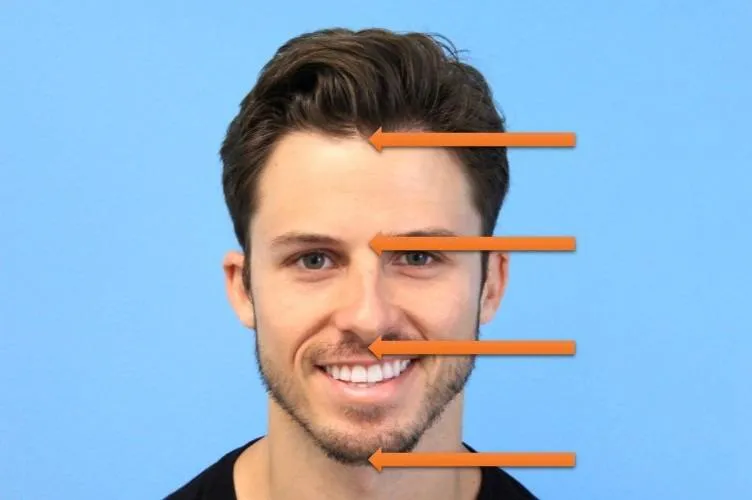
A more reliable approach places the central starting point roughly 7 to 10 cm above the brow ridge, then adjusts within the gentle curve where the forehead meets the scalp.
From there, the line is tailored to bone structure, the extent of loss, and donor supply. Whether someone has a normal or larger forehead, the goal is harmony, not a fixed number.
For some patients, restoring a more youthful frame means lowering the edge just enough to balance a tall forehead, often described as more than four fingers in height. A higher central point may be the right call when loss is advanced or donor supply is limited.
When planning a frontal restoration, we assess not just recession but the ideal starting point based on facial thirds and forehead height. A customized plan ensures the result suits your unique proportions.
Key Factors in Planning
Several variables influence the optimal position of the front line, including facial features, age, ethnicity, and the type of loss involved. No single template fits everyone, which is why the plan is drawn for each face individually.
Customizing the Front Line to Facial Structure
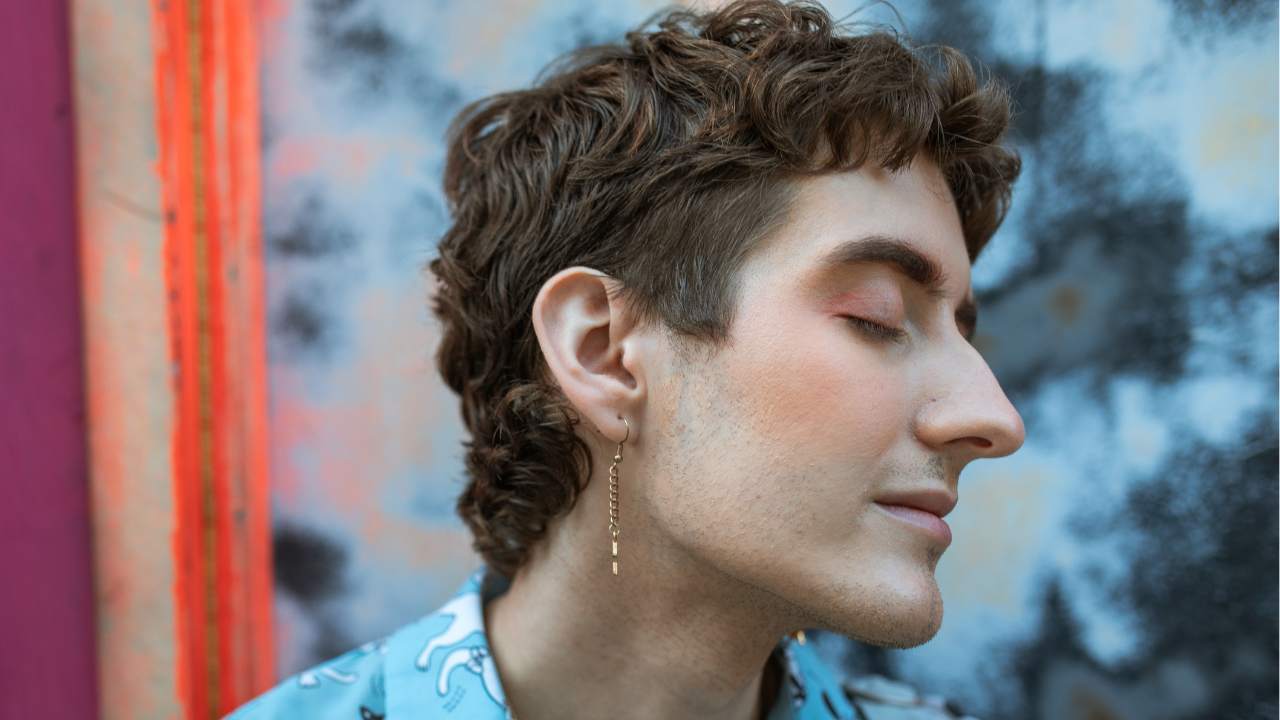
Your features help decide the ideal shape. A round face often suits a softer, curved edge, while a square face may carry a straighter line well. Men and women need different approaches, since male pattern loss tends to recede more at the temples.
For patients in New York City, facial balance often goes beyond the scalp. Many people exploring restoration also look into eyebrow hair restoration in NYC to maintain facial proportions.
Age and Long-Term Positioning
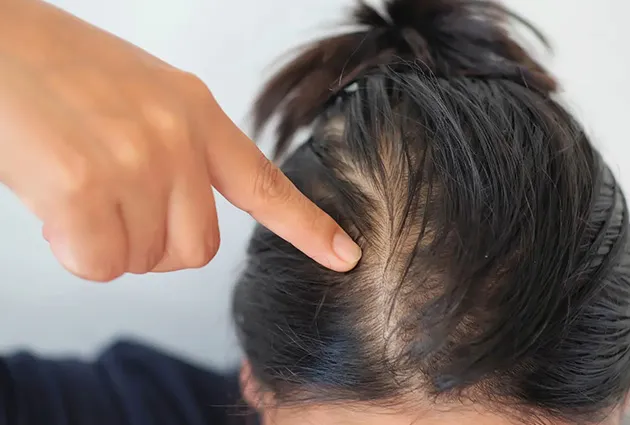
A strong plan accounts for aging. A line set too low may not wear well over decades, while one placed too high can look severe. The right balance keeps the result believable for the long term. Patients with androgenetic alopecia or frontal fibrosing alopecia should also plan for future shedding.
Ethnicity and Natural Variation
Different ethnic backgrounds carry different patterns. Texture and the way loss progresses vary, so the design must fit each individual. In several groups, including Black, Middle Eastern, Asian, and Hispanic patients, broader, flatter fronts with less temple recession are common, and the plan adjusts accordingly.
People with traction alopecia, common with tight hairstyles, may need extra care. You can also learn more about correcting high or uneven hairlines, especially for women experiencing frontal recession.
Shape: Straight vs. Curved
The right contour depends on facial shape, genetics, and preference. Some people prefer a structured, straighter look, while others like a softer, rounded edge. A curved design is often chosen for those with a tall forehead, since it visually reduces height and adds balance.
Density and Gradual Transitions
A natural front should shift density smoothly, copying how real growth thins toward the edge. Single-strand grafts go in the very front, with thicker, multi-strand grafts placed behind them.
Surgeons typically work at incisional densities around 25 to 35 follicular units per square centimeter, building fullness without a sudden wall of density.
Direction and Angle
Placed follicles should match the natural exit angle to avoid an artificial look. The angle changes by region: roughly 30 to 45 degrees in the mid-scalp, a more acute 15 to 20 degrees along the front, and nearly flat, around 5 to 10 degrees, at the temples.
| Do | Avoid |
|---|---|
| Plan for future thinning, especially in younger patients | Setting the leading edge too low |
| Use single-strand grafts at the very front | Packing multi-strand grafts into the front row |
| Keep micro and macro irregularity along the edge | Flattening or overfilling the frontal-temporal angle |
| Match the natural exit angle by region | Misdirecting grafts or angling them upward |
| Stay conservative when donor supply is limited | Relying on finger-counting alone for placement |
Getting the angle right, especially near the temples, is what lets new growth blend with what is already there.
Techniques for a Balanced, Natural Result
Creating a believable front requires symmetry, the right density gradient, and long-term planning. Careful, staggered graft placement is essential, and surgeons often build the design in several passes rather than a single pass.
Common Mistakes to Avoid
The biggest error is setting the leading edge too low, which looks unnatural and worsens with age. Relying only on counting fingers on the forehead, without adjusting for proportion, can push placement too high or too low.
Other frequent mistakes include flattening or overfilling the frontal-temporal angle, packing multi-strand grafts at the very front, and ignoring future loss, which can later leave isolated growth surrounded by thinning scalp.
Non-Surgical Options for Enhancement
Not everyone is ready for surgery. Some treatments slow the loss or improve the look of the front without an operation.
Medications:
- Finasteride (Propecia): Blocks DHT, slowing hair loss in androgenetic alopecia.
- Minoxidil: A topical solution that stimulates growth.
- Supplements: Vitamins and minerals that support follicle health.
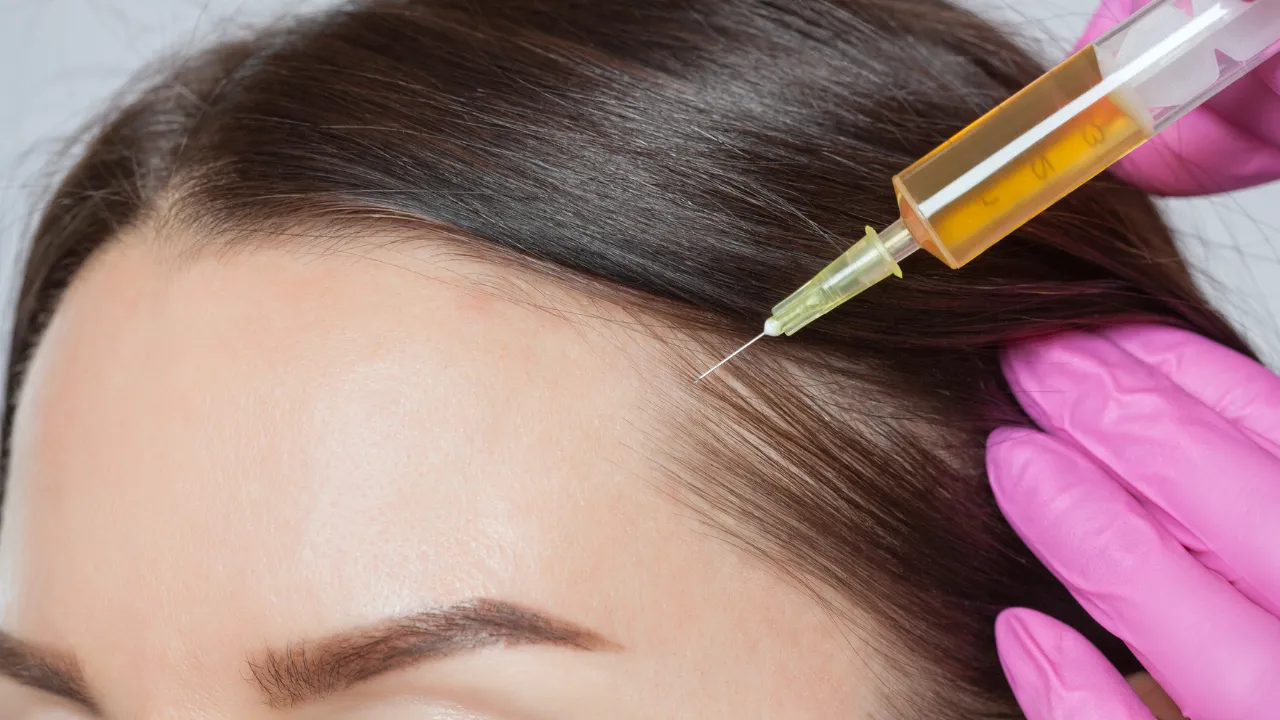
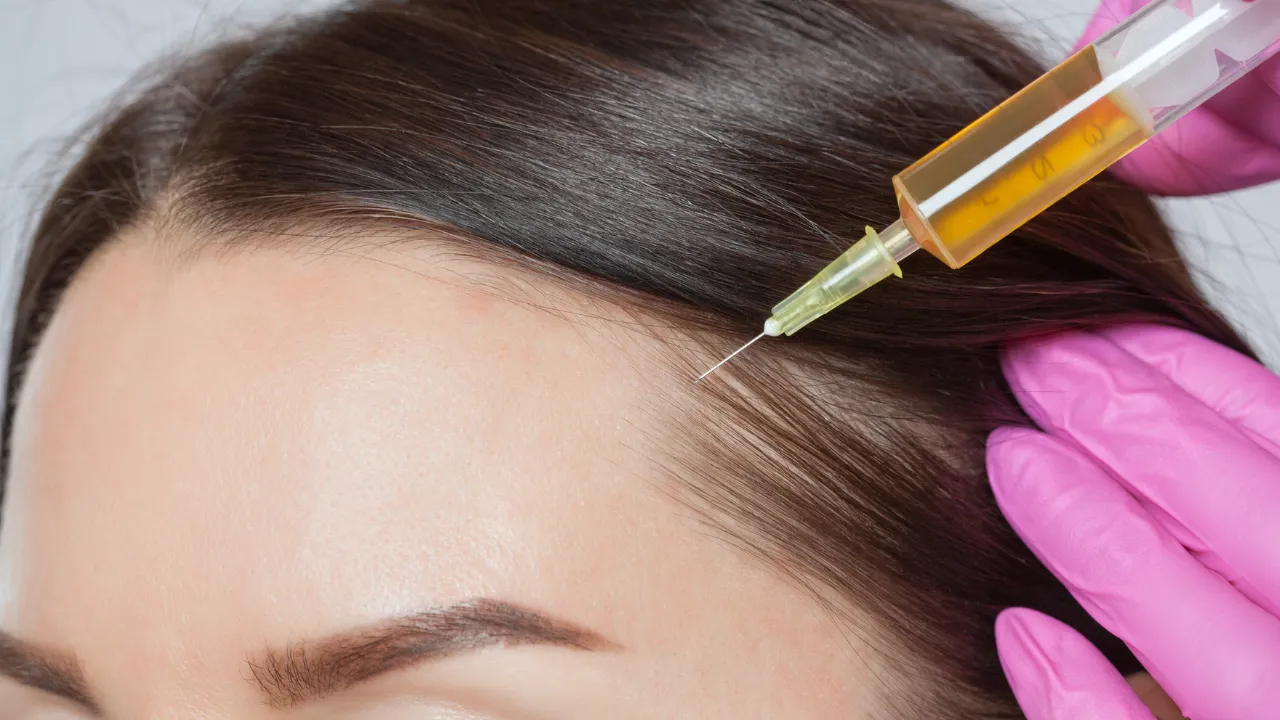
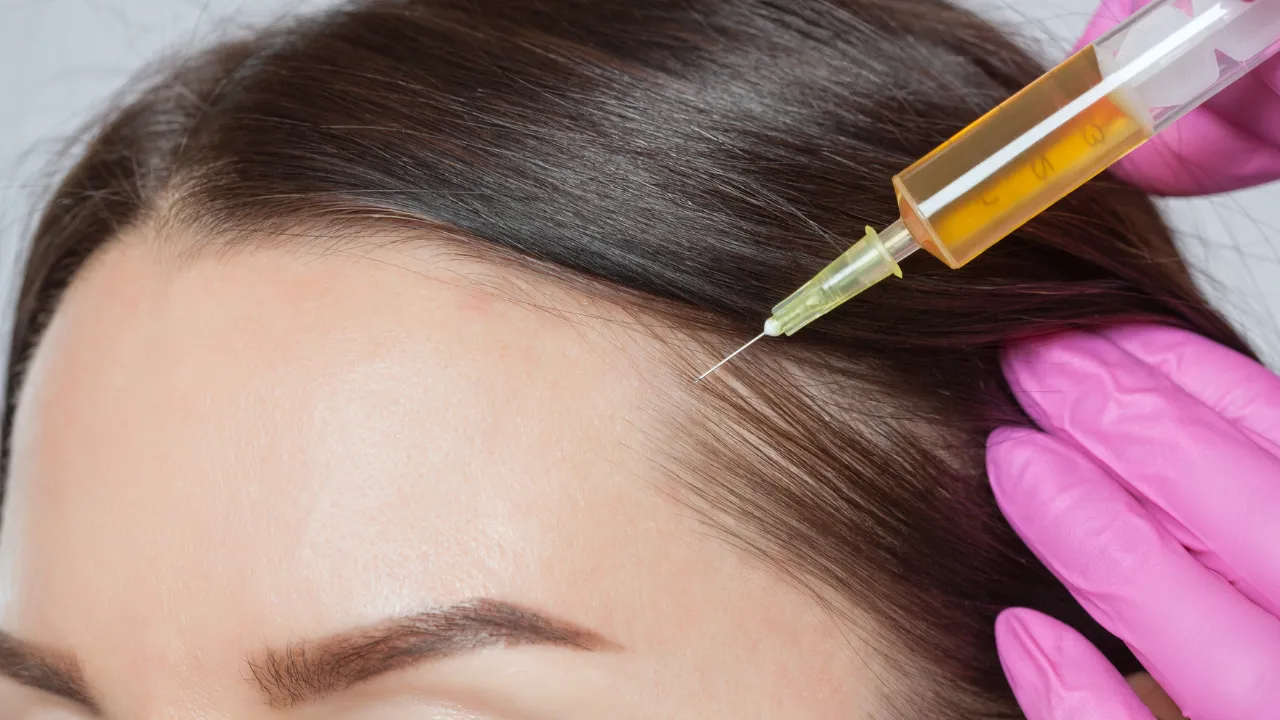
PRP (Platelet-Rich Plasma) Therapy: PRP uses a patient’s own blood to promote healing. It works well in early-stage cases and can improve density.
Scalp Micropigmentation (SMP): SMP is a cosmetic tattooing method that makes the scalp appear fuller by mimicking hair follicles. It helps with male pattern loss or limited donor supply.
Recovery and Aftercare
Good aftercare is key to healing well. Following the right steps protects the grafts and supports the best outcome.
Immediate aftercare tips:
- Avoid touching or scratching the treated area.
- Sleep with the head elevated to reduce swelling.
- Use prescribed medications and shampoos as directed.
Expected growth timeline:
- First 2 weeks: Scabbing and shedding of the placed grafts.
- 3 to 4 months: Early signs of new growth.
- 6 to 12 months: Noticeable improvement in density.
How to Choose the Right Clinic
The clinic you choose strongly affects your result. While a basic visual app might offer a rough estimate, only a qualified surgeon can build a customized, natural-looking plan.
What to look for in a surgeon:
- Board certification and experience in frontal design.
- A strong portfolio of before-and-after results.
Questions to ask during a consultation:
- What is my expected growth timeline?
- How will my front line be designed for my features?
- What techniques do you use to plan for future loss?
What to Expect on Cost
Pricing depends on several factors, and knowing them helps you plan. Frontal-focused work usually requires fewer grafts than full coverage, typically 500 to 1,500 grafts, depending on the extent of recession and the density goal.
| Scope of work | Typical graft range | Estimated cost (US) | What it usually covers |
|---|---|---|---|
| Temple point or minor edge refinement | Around 300 to 800 grafts | Lower end of the range | Softening or rebuilding receded temple points and small gaps |
| Frontal-focused restoration | 800 to 1,500 grafts | $6,000 to $10,500 | Rebuilding the leading edge and front zone for a fuller frame |
| Edge lowering after forehead reduction | Within the 800 to 1,500 graft band | $6,000 to $10,500 | Bringing a tall forehead into better proportion |
| Front plus partial mid-scalp | 1,500 to 2,500+ grafts | Scales above the frontal-only range | Front coverage extended into thinning behind it |
| Figures are estimates. Final pricing depends on graft count, extent of loss, design complexity, and clinic location. See the linked cost guide for a full breakdown. | |||
For a full breakdown, see our guide on hairline transplant cost and what drives pricing.
Factors that influence price:
- The extent of loss and the number of grafts needed.
- The type of loss, such as androgenic alopecia or frontal fibrosing alopecia.
- The clinic’s reputation and location.
- Maintenance care, such as finasteride (Propecia), to maintain results.
Surgery vs. Temporary Solutions
Medications like finasteride (Propecia) slow the loss, but a transplant offers a lasting result. The upfront cost is higher, yet the long-term value often makes it worthwhile. Patients with a history of pattern loss may combine both for the best outcome.
Your Restoration Journey
A well-built front boosts confidence and looks natural. Whether you are addressing androgenic alopecia, frontal fibrosing alopecia, or a receding hairline, expert care matters, especially for women seeking natural, long-term results.
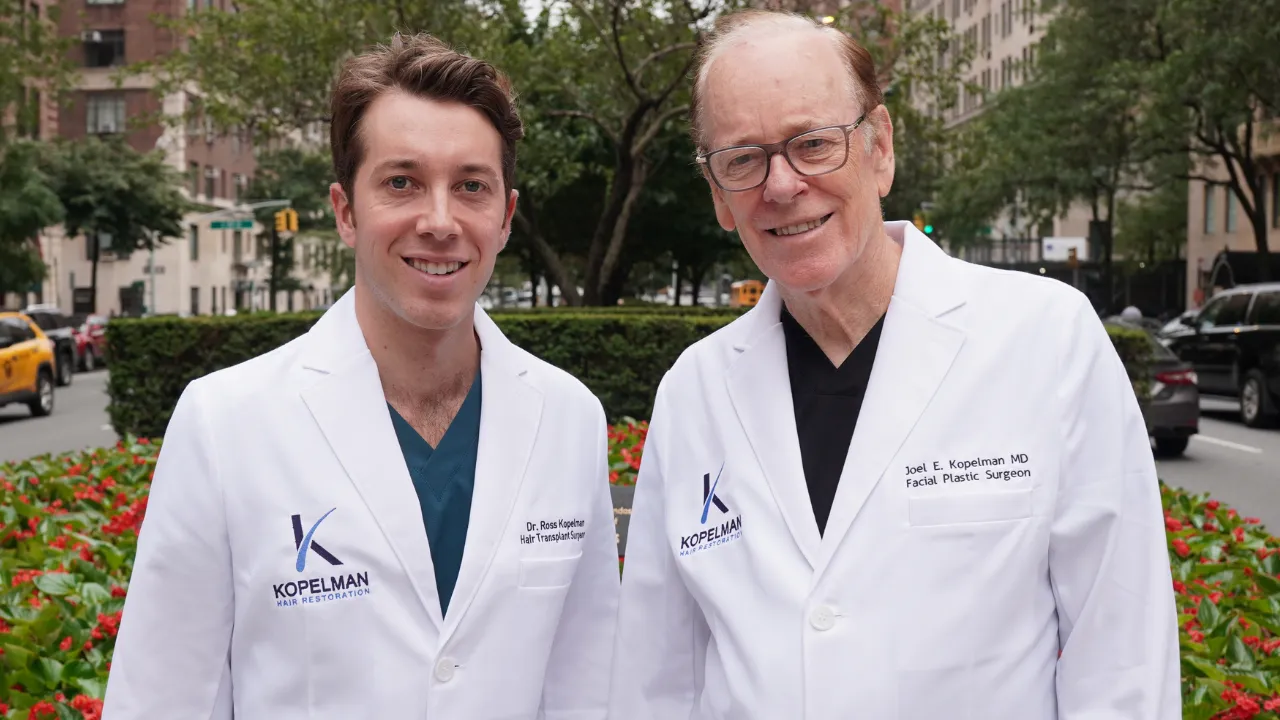
Dr. Kopelman and his team provide customized plans built around each patient. Schedule a consultation today.